Tuesday, October 25, 2011

An Exceptional Exponential Embedding

This week in class I get to teach one of my favorite probability arguments, which makes use of a very unusual embedding.  Here's a short description (for the longer description, see the book or the original paper, where the idea is ascribed to Rubin).

The setting is balls and bins with feedback:  I have two bins, and I'm repeatedly randomly throwing balls into the bins one at at time.  When there are x balls in bin 1 and y balls in bin 2, the probability the ball I throw lands in bin 1 is x^p/(x^p+y^p), and the probability it lands in bin 2 is y^p/(x^p + y^p).  Initially both bins start with one ball.  The goal is to show that when p is greater than 1, at some point, one bin gets all the remaining balls thrown.  That is, when there's positive feedback, so the more balls you have the more likely it is that you'll get the next one in a super-linear fashion, eventually the system becomes winner-take-all.

We use the following "exponential embedding".  Consider the following process for bin 1.  At time 0, we associated an an exponentially distributed random variable X_1 with mean 1 = 1/1^p with the bin.  The "time" that bin 1 receives its next ball is X_1.  Now it has two balls.  We then associate an exponentially distributed random variable X_2 with mean 1/2^p with the bin.  And so on.  

Do the same thing with bin 2, using random variables Y_1, Y_2, ...

Now, at any point in time, due to the properties of the exponential distribution -- namely, it's memoryless, and the minimum of two exponentials with mean a_1 and a_2 will be the first with probability proportional to 1/a_1 and the second with probability 1/a_2 -- if the loads in the bins are x for bin 1 and y for bin 2, then the next ball will fall into bin 1 is x^p/(x^p+y^p), and the probability it lands in bin 2 is y^p/(x^p + y^p).  That is, this exponential process is equivalent to the initial balls and bins process.

Now let X = sum X_i and Y = sum Y_i.  The infinite sums converge with probability 1 and are unequal with probability 1.  So suppose X < Y.  Then at some finite "time" in our exponential embedding, bin 1 receives an infinite number of balls while bin 2 just has a finite number of balls, and similarly if Y < X.  So eventually, one bin will be the "winner" and take all the remaining balls. 

In my mind, that's a beautiful proof. 

Saturday, October 22, 2011

ITCS Review

The list of accepted papers for ITCS (Innovations in Theoretical Computer Science) is up. 

Some thoughts:

1)  I have expressed reservations in the past about ITCS, based on the idea that it was creating another conference similar to FOCS and STOC, where instead we should be "fixing" FOCS and STOC, for example by expanding it.  I suppose my reservations this year are muted.  While the titles don't suggest to me that ITCS is necessarily a home for more "innovative" papers than FOCS/STOC, there seems to be no inclination to expand these conferences, so why not have yet another conference where 40 very good papers can go?  (Indeed, why not make it a bit larger?  I'm not sure how many submissions there were;  hopefully someone can confirm, but I'd guess the acceptance rate was roughly 20-25%?) 
2)  Another issue was ITCS was in China it's first two years, making it seem a bit "exclusive".  (Not to Chinese researchers, of course;  and not to authors, who were given funds for the trip.  But it is a far distance to go for others.)  This year, it will be at MIT, which hopefully will attract people from up and down the East Coast (weather permitting), and help it build up a longer term audience. 
3)  5 out of the 40 papers have Quantum in the title.  Should this be telling us something?
4)  Talk I'm most looking forward to:  Compressed Matrix Multiplication by Rasmus Pagh.  (I've already read and enjoyed the paper.)  But I'm also looking forward to seeing Algorithms on Evolving Graphs, if only based on the title. 

Thursday, October 20, 2011

An Apple a Day

Reviewing papers for a conference is a slow, time-consuming process.  Suppose you had 20 reviews due and about 4 weeks to do them.  What's your approach?

I take the tortoise approach.  I first try to do a quick pass over all the papers to at least have some idea of the topics and themes I'll be dealing with in the papers.  This lets me find papers that, at least on a fast first reading, seem unusually good or unusually bad, and lets me see if any papers are sufficiently related that they should be compared to each other implicitly or explicitly when I do my reviews.  But then, I try to set aside time to do one review a day, more or less.  I'll enter the review, press the button, and put it up for others to see.  I won't go back and revise things until the first round is over unless another paper I'm reading or another review I see makes me rethink substantially.  At the end, I'll go back and check that my scores seem consistent, given that I've seen my full set of papers.  Slow forward progress, with an eventual finish line.

Doing a paper a day does mean I limit the time I put into each review.  While there's some variance, I almost never let myself go down a rabbit hole with a paper.  That's not always a good thing;  sometimes, finding a bug in a proof or a similar serious flaw in a paper takes several hours of careful thought, and unless I pick up that's there a problem right away, I often miss it while going on to the next review.  (This is just one good reason for why we have multiple reviewers!)     

Perhaps another reason this is not always a good strategy: I'm told it's noticed that my reviews are actually done on time, and apparently this leads to people asking me to be on PCs.  

Tuesday, October 18, 2011

John Byers on WBUR

Listening to my co-author, John Byers, streamed live on WBUR, discussing our work on Groupon.  Ben Edelman is another participant in the show.

Here's the link.   

Wednesday, October 12, 2011

Listen

A colleague outside theory (but inside computer science) recently brought up an interesting question with me that seemed like a possible research-level issue.  We had some back and forth, trying to figure out what we each meant (naturally, our "vocabularies" are a bit different in how we describe the problem), what the actual question was, and if there was a direction to go.  After a couple of rounds of this, he thanked me.  Paraphrasing:  "I appreciate your patience.  My experience is other theorists are often immediately dismissive to these sorts of questions."

I was taken aback.  First, I'm not sure patient is a word commonly used to describe me.  Second, this colleague is a first-rate genius (with the track record to prove it).  Who wouldn't listen to what they have to say?  Quite frankly, I was happy they were interested in talking to me!

But it's been gnawing at me.  If a high-powered colleague outside theory has this impression of theory and theorists, how do we appear to others?  Was this an isolated opinion, or a common feeling?

I know 20 years ago, back when I was in graduate school, the theory/systems divide was quite large, at least at Berkeley.  There seemed to be minimal communication among the faculty groups.  Indeed, in part that was one reason that, at the time, the LogP paper seemed like such a big deal;  Dick Karp had successfully crossed over and worked with the systems side to build a model for parallel computation!  It was, sadly, notable, if only because such collaborative work had seemed so rare.

I've generally felt that while this theory/systems divide was still much larger than I might personally like that there had been a lot of progress since my grad student days.  I feel I can point to a significant number of examples.  But perhaps I'm holding the unusual opinion.  Maybe there's still not enough listening going on, in at least one direction.
 

Monday, October 10, 2011

Reading Confidence Men

My current spare time reading* is Confidence Men, Ron Suskind's book on Wall Street and the Presidency.  Without "taking sides" with regard to Larry Summers, I have to admit enjoying reading this paragraph:

"It all boils down to the classic Larry Summers problem:  he can frame arguments with such force and conviction that people think he knows more than he does.  Instead of looking at a record pockmarked with bad decisions, people see his extemporaneous brilliance and let themselves be dazzled.  Summers's long career has come to look, more and more, like one long demonstration of the difference between wisdom and smarts."

In Summers's defense(?), there are lots of people who would fit this description...

* As a parent who tries to read what my kids are reading, my future spare time reading looks to be the similarly political but less timely Mockingjayand the new-to-me series Artemis Fowl.  Recommendations for 8-10 year-old readings welcome.

Sunday, October 09, 2011

Submissions, A Comparison

I just got my set of NSDI papers to review, and have been looking them over.

One thing that immediately strikes me as I give them a first quick pass is how nice it is that the submissions are 14 double-column pages.  The authors have space to present a meaningful introduction and a reasonably full description of and comparison with related work.  They can include (detailed) pseudocode as well as description of their algorithms.  They have space for a full page (or more) of graphs for their experimental results, and even more space to actually explain them.  The papers actually make sense, in that they're written in sequential order without having to flip over to "appendices" to find results.  The phrase "this will appear in the full paper" appears rarely -- not at all in most papers.  The papers are, as a consequence, a pleasure to read.  (Well, I can't vouch for the actual content yet, but you get what I mean.)

As a reviewer, it's also nice that if I tell the authors they've left out something that I think is important, I'll generally have confidence they'll have space to put it in if the paper is accepted, and that it's a reasonable complaint to make, in that they ostensibly had space to cover my issue.  (There are some papers which fill the 14 pages and perhaps won't have something obvious that could be removed, but experience suggests they'll be rare.)    

So I wonder again why theory conferences have 10-page single-column submission formats ("appendices allowed"!), or, even worse, for conferences like ICALP and ESA, they have final page counts of 10-12 pages in the over-1/2-blank-page LNCS format.  (Really, it's just about enough space for an abstract, introduction, and pointer to your arxiv version.)  Interestingly, for my accepted SODA papers this year -- which went with 10 page submissions, "full versions" attached on the back, but had 20 pages for accepted papers -- both sets of co-authors didn't want to bother when the final submission deadline came around to filling the 20 pages, figuring people could just be pointed to the arxiv (or eventual final journal) version.  Why create yet another version of the paper according to arbitrary page limitations?  I certainly couldn't suggest a good reason.  

On the theory side, as I've maintained for years, we're doing something wrong with our submissions, with artificial page limits creating more mindless work for authors and making decisions more arbitrary than they need to be.


Thursday, October 06, 2011

Goodbye to Steve Jobs

My Mac laptop froze today.  It was an unusual occurrence;  I turned the machine off, and for a minute it wouldn't turn back on again.  I was in a panic. 

Then it went back to normal. 

After the fact, I was wondering if my machine was having its own minute of silence.  Then I had the morbid idea -- what if Steve Jobs had the power to arrange for all Mac products and iProducts to stop working when he died?  It would be a disaster for so many of us -- not just the loss of individual data, but the loss of the platforms and devices he made reality, that so many of us use and love.

Steve Jobs may be gone, but his legacy lives on.

Saturday, October 01, 2011

New York Times

Our work on daily deals is mentioned and linked to in Sunday's New York Times (front page).  (John Byers even got a quote in!)  It was also mentioned in this week's print edition of Time magazine.  (Behind a paywall, so here's a jpeg.) 

Sadly, the name Mitzenmacher doesn't appear on these items.  ("...researchers from Boston University and Harvard..." seems to be a common phrase), so I continue to toil happily in relative obscurity.

My brother points out that this is all just an example of why print media is disappearing.  He says most anyone who might have seriously cared about our work would have heard about it two weeks ago on the Internet.  The print media is just getting to it now?   They're two weeks behind.  

Thursday, September 29, 2011

Allerton Part 2 : Venue Change?

Yesterday, I thought the best talks I saw were by Devavrat Shah and Dina Katabi.

Dev was talking about how to track where rumors start.  The model is you have a graph of nodes that have been infected (by a rumor, or disease, or whatever), and based on the the shape of that graph, you want to figure out where the process started.  To get a picture of what I mean, suppose you were looking at a grid graph, and the infected area looked roughly like a circle.  You'd expect the infection started somewhere near the middle of the circle.  They've placed this in a mathematical framework (a distribution for the time to cross an edge, starting with tree graphs, etc.) that allows for analyzing these sorts of processes.  This seems to be the arxiv version of the work. 

Dina talked about 802.11n+, which they describe as "a fully distributed random access protocol for MIMO networks. 802.11n+ allows nodes that differ in the number of antennas to contend not just for time, but also for the degrees of freedom provided by multiple antennas."  By making use of nulling and alignment, they can extend 802.11 so that instead of competing for time slots, multiple antenna systems can compete for degrees of freedom within a time slot, allowing those devices with multiple antennas to take full advantage (and in particular allowing them to overlap transmissions with devices with fewer antennas).  I would have heard about it earlier, I guess, if I had gone to SIGCOMM this year.  The project page is here.

There's a whole session this morning on "mean field analysis" and games.  Mean field analysis (in my loose interpretation) means pretend your system gets big and turn it into a differential equation -- apparently a useful way to tackle various large-scale distributed agent/learning systems.  It's what I used to study load-balancing systems way back for my thesis (and still find an occasional uses for today).  Interesting to see it used for another set of problems.  Ramesh Johari's student (I didn't catch which one) gave a talk on a really interesting model of dynamic auctions with learning where you could gain some real insight using a mean-field analysis.  (How much should agents in an auction "overbid" when they're learning their value for winning an auction?  It depends on how much they think they'll gain in the future based on what they learn about their true value.)  This seems to be a preliminary version of the work. 

Now for the "negative" -- something I'm going to suggest to the Allerton folks.  It's time, I think, to find a different location.  The Allerton conference center is very beautiful, but it's not suitable, in many respects, for this event any more.  I was told there were about 330 registered attendees from outside UIUC, plus an additional 120 or so from UIUC.  It's a bit hard to turn that into a true count;  many (most?) UIUC people probably drop by 1 day, most attendees probably 1.5-2 days of the three.  But Allerton really wasn't designed for a crowd that large.  If you're not in one of the "big rooms", and people want to come to your talk, many times they can't get in.  For example, the social network session was remarkably popular;  the room could seat 40 people, and there were about 20+ people crowded around and outside the doorway -- which was not only not ideal, but it was also disruptive, as the open door meant a lot of noise in the room.  Actually, the acoustics aren't particularly good in any of the rooms, even the big ones.  Attendance in the early am is very low, in part I think because people staying "in town" have a non-trivial drive to get to Allerton. 

When the event was smaller, like 200-250 people, everyone coped with these problems.  It's really not working now.

I can understand there's an attachment to the Allerton center -- and how could it be the "Allerton conference" (next year is it's 50th year!) if it wasn't at Allerton?  But this has been an issue for years, and only seems to get worse.  There must be a conference venue on or near UIUC campus that would work as well -- at the very least, my opinion is it's time to look....

And now, back to the airport...

Wednesday, September 28, 2011

Allerton 2011

I woke up at an absurdly early hour this morning to get on a plane and go to the Allerton conference.  I'm giving a talk this afternoon on Invertible Bloom Lookup Tables (arxiv link) (joint work with Michael Goodrich).  It's a "lookup table", not a Bloom filter, because you want to be able to store key-value pairs;  you query for a key, and get back a value.  It's invertible, because besides being able to do lookups, you can "invert" the data structure and get back all the key-value pairs it contains (with high probability, assuming you haven't overloaded the structure).  This paper is really on the theory, but if you want to see a cool use for IBLTs, there's a paper by Eppstein, Goodrich, Uyeda, and Varghese from this year's SIGCOMM (Efficient Set Reconciliation) with a compelling application.

Allerton is a different sort of conference, as I've discussed before (like here and here, among others).  A mix of invited and submitted papers, a wide diversity of topics, lots of parallel sessions.  It seems absurdly crowded this year -- I had to park in the ancillary parking because the lot was full, and the rooms where the talks are held all seem to be bursting.  (The conference, unfortunately, really has outgrown the space where the conference is held.)  I'm guessing well over 300 registered;  I'll have to check.  The conference gives me a chance to catch up with colleagues who are more on the EE/networking side;  I've seen other CS theorists here in years past, but I haven't noticed anyone yet. 

If you're here, maybe come by my talk this afternoon, or say hi if you see me hanging around.

Tuesday, September 27, 2011

Set Competition

As an applied probability exercise, I had my class compute empirically the probability of a game failing on the nth round for the game of Set.  (See my previous post about this;  here failure means there's no set on the nth round, and they were asked to implement the "choose a random set" strategy if there was more than one.)  They were also supposed to try to calculate the probability of using all 81 cards in sets through the course of the game -- what we might call a perfect game.

Some students explored a bit and noted that changing from the random strategy could significantly increase the probability of a perfect game.  So I think the next time I decide to use this assignment, I'll turn it into a competition.  Students will have to develop a strategy that maximizes the probability of achieving a perfect game.  Prizes will go to the best strategy (which hopefully could be easily determined after a few billion runs or so -- I suppose I'll have to introduce some sort of computational limits on the strategy to ensure that many runs can be done in a suitable time frame), and the best "succinct" strategy -- that is, the best strategy that can be described in English in at most a few reasonable sentences. 

It's also interesting to think about optimal strategies in the offline case, where the permutation determining how the cards will be dealt out is given in advance.  I keep thinking maybe there's a way to effectively calculate whether a perfect game can be found for a given permutation, and then thinking there can't be.  (Though, admittedly, I haven't thought a lot yet.)  So maybe it makes sense to run the competition for both the online and offline versions of the problem.  

Wednesday, September 21, 2011

Beyond Worst Case Analysis Workshop

I'm just off a plane coming home from the Beyond Worst Case Analysis Workshop at Stanford.  It went really well, and I really enjoyed it.

I think a variety of things made it work.  First, and I apologize to Tim Roughgarden for saying it, but the execution was superb -- someone should make him organize more things.  Great room, great food, great staff on hand (thanks to Lynda Harris for being incredibly helpful), and a great collection of speakers.  Also, an excellent location.  Stanford is relatively easy to get to with 2 major airports nearby (but avoid the cabs -- it's now over $100 to take a cab from SFO!), and the location guarantees an audience of Stanford, Microsoft, and Google folks.  (While not everyone was there all the time, I understand well over 100 people were registered.)

To the content.  It was a great program -- apparently the talks will be on the web later, so you may want to check them out if you weren't there.  My favorites would have to be Dan Spielman's talk on smoothed analysis (perhaps because Dan just always gives great talks), and Kevin Leyton-Brown's talk on statistical methods (using learning theory) to predict an algorithm's performance on new instances.  (Can you predict the running time of your satisfiability algorithm accurately before running it on a specific instance very quickly just by taking a careful look at the problem?  The answer seems to be -- yes you can!)

There was a panel that focused on questions like "Where could we point students to work on these sorts of problems.  What are the currently most glaring examples of algorithms whose properties are poorly explained by existing theoretical models, where there might be hope for progress?"  and "To what extent can "real-world data" be modeled? Is it important to model accurately the properties of "real-world data"?"  While the panel ended up being fairly uncontroversial -- I'm afraid no fights or even major disagreement broke out --  I found it very interesting to listen to the others on the panel give their opinions and insights on these questions.

I think people got into the spirit of the workshop.  Kevin, an AI person by trade, found it amazing that  theorists were getting together to talk about heuristics and experiments.  (Kevin's talk was followed by Dick Karp talking about his work on tuning and validating heuristic algorithms -- though of course not all talks were on that theme.)  It will be interesting to see if this workshop inspires any specific new research -- but even if not, it was well organized, well put together for content, and well worth the trip. 

My talk slides are here.  

Tuesday, September 20, 2011

Guest Post on NYCE (Giorgos Zervas)

GUEST POST by GIORGOS ZERVAS

I was at NYCE 2011 this past Friday. It was a thoroughly enjoyable and productive experience. I feel like I got a conference's worth for the cost of and time commitment of a long commute.

The day started with three hour-long plenary talks, followed by lunch and a poster session, followed by an hour of 10 minute talks, and concluded with two more plenary talks. (And all of that for about $20.)

It turns out a lot can be squeezed into 10 minutes. Halfway into the first speaker's talk, with 5 minutes left on the clock, I was almost convinced he was running out of time. Everyone worked great around the time constraint to succinctly deliver their talks.

The plenary talk roster was varied and exciting (at least by one other account). I particularly enjoyed Jonathan Levin's talk on eBay experiments (pdf of the paper) in part because I was least familiar with it, and in part because I think I can use his key method. Here's the gist: instead of relying on random observations look for experiments that have been conducted on your behalf by market participants. To use his eBay example, auctions have a bunch of parameters: the item, its starting price, its reserve price, and so on. Quite often it turns out you can find sets of auctions ("experiments") that are identical in all but one parameter. This allows you to directly quantify the effect of the varying parameter. To say I wish I'd thought of this is an understatement -- I am trying to convince myself that I actually didn't. (I didn't.)

Of interest -- likely to myself only -- was the passing mention of Swoopo in two plenary talks. Their sudden demise still puzzles me. While writing our Swoopo paper they were running about 200 auctions a day. A few months after EC'10 when I checked again they were running about one hundred. They were responding to reduced demand but why were "entertainment shoppers" driven away? The business model certainly did not die as others have successfully taken Swoopo's place. One possibility is that the barrier to entry in this type business is low. Around Swoopo's peak there were people making money off penny-auction scripts they'd sell for a few hundred bucks. Hundreds of clones sprung. Buy a script and some hosting, run auctions, and ship directly from Amazon. In an interesting parallel the daily deals business also seems to have a very low barrier to entry judging from the hundreds of Groupon clones. I am still kicking myself for stopping data collection after our Swoopo paper was done.
Back to NYCE itself, if there is one thing I'd maybe have wanted to see more of is student talks (especially of the 10 minute variety). I guess the poster session made up for this but as someone with a poster to present I didn't have to chance to walk around and see others'. Which reminds me, thanks to everyone who stopped by my poster, and to the organizers for putting everything together!

Friday, September 16, 2011

Travels and Teaching

I'll be at the Beyond Worst Case Analysis workshop next week, and Allerton the week after.  For each, I'll have to miss a class.  I also have some other travels that may involve missing classes this semester as well -- I'll be missing more class than usual this semester, but they're for good reasons.

I'll have Justin and Giorgos cover a lecture for me (thanks, guys!), but next week I'm doing an experiment:  I'm substituting videos for my class.  I've pointed them to 2005 MSRI workshop Models of Real-World Random Networks, and having them watch some talks.  One is my survey talk on power laws, so it's still "me" teaching, but then I have a few impressive "guest lecturers" from the workshop to cover the rest; all the talks focus on power laws in some way.  I've even put together an "in-class" exercise for them to do on the subject -- out of class, of course.     

I wonder if this is a good approach or not.  I'll have to ask the students.  It's not ideal, but either is cancelling class.  Has anyone else started using videos as a solution to the missed lecture problem?  Are there ways to make it a more useful experience?

By the way, looking back, that 2005 MSRI workshop had a bunch of interesting talks.  Worth checking out sometime if you're interested in the area.  I looked younger then. 


Reminder : Giorgos has a poster at the New York Computer Science and Economics Day today.  Go check it out!

Thursday, September 15, 2011

This Week, I Am Part of an Internet Meme

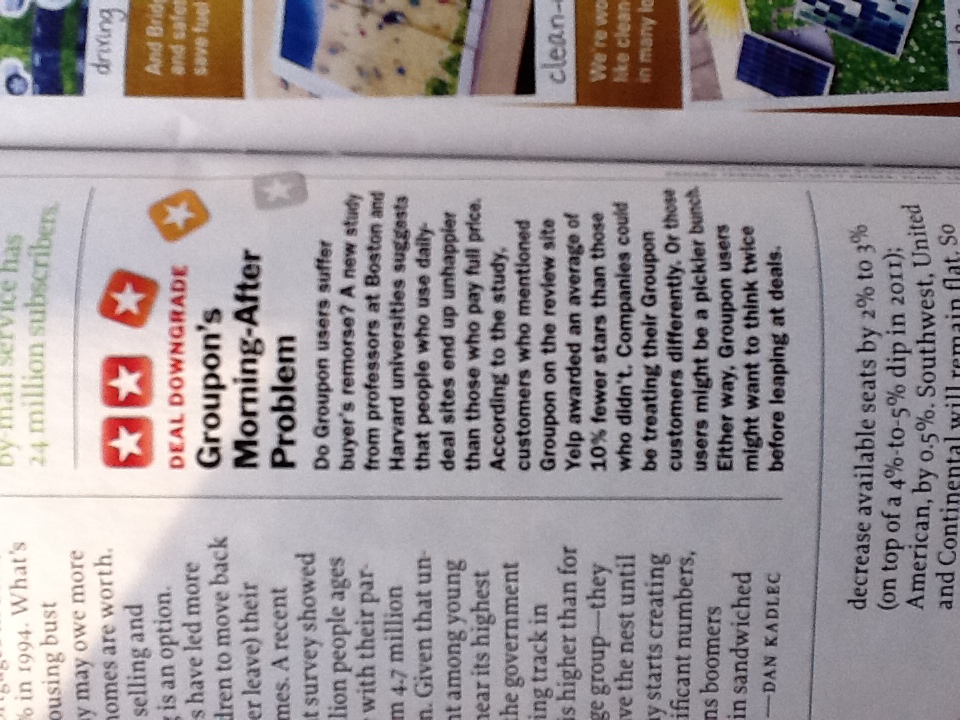
My frequent co-authors John Byers, Giorgos Zervas, and I posted an extended version of a current submission to the arxiv (as people do), which showed up last Friday or thereabouts.  Daily Deals: Prediction, Social Diffusion, and Reputational Ramifications discusses some analysis we did on daily deal sites (Groupon, LivingSocial), including interactions between daily deal sites and social network sites (Facebook, Yelp).  

The work got a plug Monday on the MIT Technology Review. They naturally focused on our most "controversial" finding, and I quote them:

"A Groupon deal might boost sales but, it can also lower a merchant's reputation as measured by Yelp ratings, say computer scientists who have analyzed the link between daily deals and online reviews."

Apparently, many people are interested in statements of that form, especially business types, and that's where the fun started.  We got some e-mails from people who work for firms that use statistical analyses in planning marketing efforts who had seen the article (and wanted our not-yet-released data set).  We noticed the review article was getting tweeted.  We started tracking a tweet feed to find out where else it was showing up.  (As a very partial list, Business Insider, Chicago Tribune, The Independent, Search Engine Journal.)  Monday we were worried that people might try to actually call us up and talk with us, but fortunately, that hasn't happened.  Instead of feeling pressured, we've just been able to enjoy watching.  

It's amusing to see how these things spread through the Internet. A lot of sites are just cutting and pasting from the MIT Tech Review. I know this because, in what I personally find to be the most amusing of mistakes, they refer to Giorgos as "Georgia Zervas". Giorgos does seem to have multiple name spellings (he also uses Georgios), but Georgia is not quite right. (It is, however, my new nickname for him*.)  Georgia Zervas, according to Google, has popped up almost 200 times in the last 3 days.  

We weren't really expecting this.  I think part of the reason we didn't expect much reaction is pre-summer we put up a placeholder with some initial data:  A Month in the Life of Groupon.  This didn't seem to get much notice.  Indeed, we had submitted it to NetEcon, and were essentially told by reviewers the paper was too boring.  I must admit I disagreed, then and now, with the reviewers.  But, to be fair, that version of the paper didn't contain the data sets and analysis for LivingSocial, the Facebook Likes, and the Yelp reviews;  it just had Groupon data (though we made clear this was an "appetizer" and more was to come).  John actually completely disagrees with me.  I quote:  "For the record, I agree with the NetEcon reject decision.  They should be applauded for making us do more work."  My take was the bar for a workshop paper was too high if this wasn't sufficiently interesting.  Giorgos wonders if by John's logic we're hoping the paper gets rejected again.  

Also, we didn't get nearly the same sort of attention for our previous similar-in-spirit work analyzing penny auction sites like Swoopo (entitled Information Asymmetries in Pay-Per-Bid Auctions:  How Swoopo Makes Bank).  Daily deal sites are MUCH bigger, and I suppose the results for Swoopo are a bit harder to summarize for mass consumption.

Anyhow, Giorgos will be at the New York Computer Science and Economics Day this Friday with a poster on the subject.  Stop by and talk with him!  (Giorgos recently completed his PhD at BU, and is doing a Simons postdoctoral fellowship with Joan Feigenbaum, while also hanging out some with me at Harvard as an affiliate of our Center for Research on Computation and Society.)   
  
* Don't worry Giorgos.  I'm kidding.  Sort of.

Wednesday, September 14, 2011

SODA Accepts -- The Count

People in various have been noting the SODA accepts, but nobody has been talking about the numbers.  I count 138 papers accepted.  I can't find now how many submissions there were;  I recall it was over 600 abstracts, but I think it cut down to 520-540 or so.  So this seems like just over 25%.

Is that a good number?  Too many?  Too few? 

I admit, I have trouble believing that there weren't at least 40, 50, maybe 100 of those rejected submitted papers that were of sufficient quality that it would have been just fine to have them in.  I could be wrong -- I wasn't on the committee -- but I'd guess there was more good stuff out there.

For those papers that were rejected, where will they go?  ICALP and ESA deadlines are pretty far off;  there aren't a lot of good homes for algorithmic papers until then.  (STOC/FOCS may not be appropriate;  other conferences and workshops have, I think, weaker reputations that may make them less desirable, especially for up-and-coming students and younger faculty.)  It seems like there's a hole in our schedule.  Rather than fill it with yet another conference, wouldn't the community be better off accepting more?

Tuesday, September 13, 2011

Rabin's Birthday Celebration

While I was not blogging, we spent the few days before the semester started with an 80th birthday workshop for Michael Rabin.  Impressively, we were able to pull it off despite the best efforts of Hurricane Irene, thanks to the many speakers who made an extra effort to get there, well beyond the call of duty.  Because some speakers couldn't make it (flight cancellations), and we were worried about storm cleanup, we postponed the start until Monday afternoon, but other than that, it went fantastically well.  (A credit to the organization of Les Valiant!)   

Richard Lipton described it all in this blog post, so I don't have to.  (The only negative thing in his post is that he refers to me as Mitz -- clearly because it's the easiest way of distinguishing me from the guest of honor, he doesn't call me that regularly -- which feels strange to me as I haven't been called that regularly since middle school.) 

If any coding theory people are reading this, I thought I'd point out that the slides for my talk (as well as the slides for many of the other talks), which was on coding theory, are available here.  In particular my talk is about how Michael Rabin's JACM paper on the Information Dispersal Algorithm was remarkably prescient, setting up some basic ideas and foundations for both the later work in LDPC codes and network coding.  While the paper is far from unknown (Google scholar has it at well over 1000 citations), I'm not sure how widely appreciated the paper is in the coding theory circles;  it was a pleasure for me to go back and reread it with new eyes to prepare for this talk. 

Monday, September 12, 2011

Blogging Again?

My thoughts that I would blog more over the summer, during academic "down time", turned out more of a fiction than I would have thought.  The summer proved remarkably busy, with plenty of research, administration, consulting (the economy must be coming back?), and, more enjoyably, time with the kids.  The blog was low priority.

With the school year starting, I actually feel I have things to say, so we'll try again.

Classes have started, and Harvard's continuing growth in CS, well, it continues.  Our intro CS course ended up with about 500 students last year;  this year, we've currently got 650 enrolled.  Our 2nd semester programming course designed primarily for majors has gone from 70 to 110 enrolled.  Most importantly for me, our intro theory course (the Turing machine class) went from about 55 to 75.  My algorithms and data structures class tends to be just a few less than that 2nd semester, so I'll have to plan for a jump up.  (My biggest year was 90, back in the (last) bubble days;  I'm not sure we'll ever get back there, as students have more class choices now.)

Really, we're trying to put more resources early in the pipeline to attract students to the intro course -- and we seem to be in a healthy positive feedback loop, which is (over time) pushing all the numbers up in later courses.  Apparently tech is popular again.   

I'm teaching randomized algorithms and probabilistic analysis, a graduate course that splits 1/2 grad and 1/2 undergrad.  Currently I have 23 students, which is a nice and healthy but not earth-shattering number. 

It's exciting to come back and see these numbers continuing to go up.  No wonder we're #2 on Newsweek's Schools for Computer Geeks.  (And no, we don't take that seriously.)  Besides giving some evidence that we're on the right track, it should make the case for hiring more in CS easier to make.

Tuesday, August 16, 2011

SIGCOMM Webcast

Got a note from the ACM that SIGCOMM is being live Webcast the next few days.  (I'm not in Toronto for it -- hello to everyone who is!) 

A simple click and I'm listening to SIGCOMM talks.  Fun.

The link is http://www.weyond.com/sigcomm/webcast/

Listen in as you can.

Monday, August 01, 2011

Fun Links, via Google+

One fun aspect of being on Google+ is occasionally a link comes along worth further notice.

The first, from David Karger, is a link to a report (by Democrats, says David) refuting a previous report (by Republicans) that had argued that the NSF was wasting a bunch of money on frivolous research.  The link is here.  Jon Kleinberg was one of the listed "frivolous" projects -- apparently studying pictures on social networks isn't considered important by those with an agenda -- and he has a brief response in the report.

The second is an editorial by S. Keshav, about the "hyper-critical attitude of paper reviewers",  spurred by the fact that CCR had no technical articles, because all the submissions were rejected.  I certainly have something to say on the issue (having, for example, recently had a conference rejection where 3 knowledgeable reviewers said the paper should be accepted, one unknowledgeable reviewer said the paper was too theoretically challenging for the systems audience, and apparently decided to take an uninformed stand at the PC meeting...).  But rather than tell a long story here, I'll just point you to the editorial....

Friday, July 22, 2011

Tact

Early in the week, I was excited to find out that, apparently, it was perfectly appropriate for us professors to call (at least, already graduated) students assholes, publicly, because if it's good enough for Larry Summers, it's good enough for me.  (Or see here as well.)  That seemed very cool to me.

But now it seems the Winklevosses are asking for redress from Drew Faust, so the question of whether I can go around openly insulting students' character without worrying about whether anyone at Harvard will care is, for now, at least somewhat open.

(Further commentary, including some people at Harvard pointing out the inappropriateness of it all, can be found at Shots in the Dark, in temporal order here, here, here.)

Beyond Worst Case Analysis -- Preparing a Talk

A few months ago, Tim Roughgarden mailed me to say was putting together a little workshop on the theme of Beyond Worst Case Analysis, and would I like to be one of the plenary speakers?  It sounded like an interesting topic, one I've certainly spoken off the cuff about on this blog from time to time.  And I enjoy any reasonably good excuse to get out to the Bay Area.  So I agreed.

The workshop announcement is here.  As you might imagine, what Tim DID NOT tell me at the time was that the other speakers were Avrim Blum, Bernard Chazelle, Uri Feige, Richard Karp, Dan Spielman, and Shang-Hua Teng.  That would have given me pause, to say the least.  Now I get to spend the summer thinking about how I'm going to give a talk that could still be deemed interesting in the company of this group of scholars.  No pressure, no pressure...

(Tim also failed to mention that he had actually taught a course on this whole subject.  Which, I should say, looks like a great course -- I'd love to swipe his notes and teach it myself some time.  Again, the bar here is higher than I had expected... let that be a lesson to everyone if Tim comes asking you for something...)

I will hopefully blog more on this topic as I prepare the talk, in order to get ideas and feedback from the community at large.  I figure that's one way to improve my talk.  Also, now that I've said I'm going to do that, hopefully it will get me working on the talk sooner rather than later.  (It's amazing how fast the summer goes by, and you fail to get done all the wonderful things you had planned to do over the summer...) 

But even now, you can help me out.  What directions or issues do you see in the theme of Beyond Worst Case Analysis, and what would you like to see in a talk on the subject?

(And if you get a chance, come to the workshop!)

Monday, July 18, 2011

Rabin's 80th Birthday Celebration

Big announcement:  We'll be having an 80th birthday conference celebration for Michael Rabin at Harvard at the end of August.  Lots of great talks by big-name CS people!  (And I'll be there too.)  The web site has all the relevant information -- schedule, directions, hotel, etc.  KEY POINT:  We need you to register in advance.  (Otherwise we won't have a head-count for food, etc.) All of us at Harvard hope you'll be able to come.  See you there!   

Formal announcement below:

On August 29-30, 2011, there will be a conference in celebration of Michael Rabin's 80th birthday at the Harvard School of Engineering and Applied Sciences.    The speakers include Yonatan Aumann, Michael Ben-Or, Richard Karp, Dick Lipton, Silvio Micali, Michael Mitzenmacher, David Parkes, Tal Rabin, Ron Rivest, Dana Scott, Madhu Sudan, Salil Vadhan, Moshe Vardi, and Avi Wigderson.


The conference is open to the public, but registration is required by August 25.  For more information, see the conference website at https://www.events.harvard.edu/web/4352.

Tuesday, July 12, 2011

SODA in Japan

I hadn't even noticed SODA was in Japan before submitting.  I just figured wherever it was I'd be willing to go, as January in Boston is a fine time to be elsewhere.  And if needed I can send a student instead...

My only past time in Japan was for ISIT back in 2003.  I remember it was a maddeningly long flight (made somewhat bearable by distracting myself with whatever was the new Harry Potter book at the time), followed by a 2 hour long wait to get through customs, followed by a 2 hour train ride to Yokohama.  I was not a happy camper when I got to the hotel.  Which, once I got there, was absolutely amazing;  a bath in the deep Japanese-style tub and some food and the grumpiness passed.  And then it was a great conference;  hanging out with an old friend and his colleague over breakfast we managed to produce a paper (which eventually ended up being this journal version -- my first and likely only paper that will appear in IEEE Design and Test.)  One day we took off and did some great sightseeing, where I depended greatly on the lead of others, not having grokked how to get around with signs in a language I didn't understand at all. 

So if I get a paper in I suppose I'll cope with the long flight and go.  Of course with 600 or so submissions it's a roll of the dice;  we'll see how it goes.

Best of luck to everyone working until the deadline....

Saturday, July 09, 2011

Using Google Scholar for More Than Your h-Index

The comments from the last post (thanks, David Andersen) spurred me to mention the following.

I do check Google Scholar for my own work fairly regularly.  Not to keep continuously updated on my h-index (though, I suppose, that's a side benefit).  But I've found it very useful to look at who is citing my work.  For older areas of research where I'm (at least temporarily) inactive, it's useful to keep track on what's gone on since I've been paying close attention.  For areas where I'm still doing research, it's helpful to know what's out there -- so I can cite it, I can see where the area is going, and I can know who is working in the area.  Keeping up to date this way can also suggest new research problems or collaborations.  Being able to access the citation graph so easily is, I think, very helpful.

I do the same thing using full-text search for myself on the arXiv, and I even Google myself on the Web.  (I've found blog posts mentioning me or this blog that I wouldn't otherwise have known about that way.)

So no, I don't think it's egotistical to check yourself on Google scholar.  I think it's just a good research practice to keep tabs on who is citing your work.

Friday, July 08, 2011

h-index != impact

Suresh and Daniel Lemire (in Google+ posts) have pointed to the following paragraph from this blog:
The sad thing is that young people have now been terrified by the Impact and H factors, and I can’t give them much hope. When I published my first paper in 1967 (J. Chem. Soc. (now the RSC), Chemical Communications) I did it because I had a piece of science I was excited about and wanted to tell the world about. That ethos has gone. It’s now “I have to publish X first author-papers in Y journals with impact factors great than Z”.
As a service to those young people, I'd like to make clear that, at least at my institution, the “I have to publish X first author-papers in Y journals with impact factors great than Z” approach is not actually suitable, and you should focus on the "I had a piece of science I was excited about and wanted to tell the world about" approach. 

I'm not being naive.  Citation counts certainly arise in promotion and tenure cases.  They're a piece of information, and we look at them.  But just as your GRE score won't get you into (one of the top-tier) graduate schools,  your h-index is not going to get you tenure (or a grant, or an award, or...)

When you come up for promotion, we ask for letters.  Some letters will mention your citation counts or your h-index as a way of providing evidence that you've done interesting and important work, and that's all well and good.  Then, what we look for, is an explanation from the scientist as to why they think your work is interesting and important.  Arguably, the best way to get your letter-writers to write a good case for why your work is interesting and important is to do work that you're excited and want to tell the world about.  Because if you are excited and go tell the world, repeatedly and with energy, the word will get out, and get to the ears of those scientists who are going to write your letters.

Of course, even ignoring those employment-relate aspects, doing science you're excited about is just more fun.

I wonder if the author of this blog post is correct in the characterization of young people, as the idea is a bit foreign to me.  In theory, of course, we have some great role models;  I don't think Les Valiant, Jon Kleinberg, David Karger, Cynthia Dwork, and so on spend their time worrying about their h-index.  They just want to do cool stuff (and, as far as I've known them, always have -- it's not a "now-that-they're senior" thing).  But just in case, let's make sure the correlation/causation message gets out right:

cool work, excitement, and enthusiasm tends to yield high citation counts and maybe h-indexes
but
citations are not how we define or even measure cool work, excitement, and enthusiasm

Wednesday, July 06, 2011

Various Goings On

I've not been a Facebook user, but I was invited to join Google+, so I set up a picture and am waiting to see what it's all about.  I'm afraid that for the most part I'm not so interested in a wall where people tell me what's going on with them, nor do I see the point in writing to groups of people I know to update them on my life this way, but perhaps over time I'll be converted to this way of socializing.  Until then, I guess I'll keep writing blog posts if I feel I have something to say (which, admittedly, has been less often these days).

600+ abstracts submitted to SODA.  I wonder what the over/under is on how many will actually be papers a week from now.  I'm expecting about a 10% drop, but wouldn't even be surprised to see it go down to 500 or so.   That suggests about a 25+% acceptance rate.  I'm not sure what message there is to take out of that.  But given that 500 seems to be the total of accepted papers for SODA, STOC, FOCS, ESA, ICALP, and maybe another conference or two after that (SPAA, PODC?), it seems like theory is (still) producing too many papers, or has too few venues to publish them in.  Larger conferences, or perhaps a large clearing-house conference, anyone?  (Would SODA be that much different if it accepted, say, 250 papers?  Discuss.) 

While I think svn is great for collaborations, I've really found the merging functionality has negligible utility.  I'm a novice user, but it seems whenever there's a conflict, the fastest way to deal with it is still to pick a winner, diff for differences, and glue together by hand.  I think the bottleneck is when there's a conflict, I want to work out differences with my colleague, and the whole point is that we're working at different times and places.  So the benefit of working separately seamlessly gets lost. 

I still think everyone should be reading Claire's blog, which covers a really nice mix of topics, many of which could potentially lead to interesting community discussions.  

Friday, July 01, 2011

Odd SODA Rules, and Other Conference Paper Complaints

Suresh points out we have some strange new SODA submission rules this year: 

Full submissions should begin with the title of the paper, each author's name, affiliation, and e-mail address, followed by a succinct statement of the problems considered, the main results, an explanation of their significance, and a comparison to past research, all of which should be easily understood by non-specialists. More technical developments follow as appropriate. Use 11-point or larger font in single column format, with one-inch or wider margins all around. The submission, excluding title page and bibliography, must not exceed 10 pages (authors should feel free to send submissions that are significantly shorter than 10 pages.) If 10 pages are insufficient to include a full proof of the results, then a complete full version of the paper (reiterating the material in the 10-page abstract) must be appended to the submission after the bibliography. The length of the appended paper is not limited, and it will be read at the discretion of the committee. A detailed proof in the appended complete version is not a substitute for establishing the main ideas of the validity of the result within the 10-page abstract.

This is totally bizarre.  11-point single column-format?  Then an appended paper beyond the abstract?

I wish I was submitting a paper on my own.  I'd just submit a standard opening abstract and my "10-page paper" would be, "Hey, I've just told you what I'm going to prove, why don't you go read my real paper, which is attached to this?"  Because, really, I'm not clear on what the point of all this is.


Having recently finished an ICALP paper and having worked today on an ESA paper, I didn't think it was possible to choose a worse format that 10 or 12 pages in LNCS format, which gives you just enough space to say, "Here, I've done something interesting, but if you want any details, go read it on the arXiv."  And I suppose this isn't really worse.  [Really, can't we all just protest the bizarre LNCS format?  Or fine, keep the format, but paper limits should be 20 pages.]  It's just strange.

Most other conference I'm involved with outside of theory have the sensible approach that you submit something that looks pretty much like what your final paper is supposed to look like.  You may only have a 5 page limit (double column, 10 point font, which I think is still well over 12 pages in LNCS format), but the reviewers sees what the paper will be.  Some conference even give a page or two extra for the final version, so you can actually address reviewer comments.  (Of course, those conferences also make a point of giving detailed reviewer comments, in some cases even having shepherds for the final papers.)   


Theory conferences are messed up with this whole page limit/paper format thing.  Someone should figure out a simpler, more coherent system.  It seems like it would be hard to come up a system that was any more random and arbitrary. 

Wednesday, June 29, 2011

UC Budget Woes

The new California budget call for $650 million in cuts to the UC systems -- I understand $500 million had already been planned, they added $150 million on top of that, and may add more later if the revenue numbers don't pan out.

I'll admit that as a long-time CA resident (that's where I grew up), and a UC Berkeley alum (for grad school), it pains me to hear this.  I'm very sympathetic to statements such as this one quoted in this San Francisco Chronicle piece:

"Some students don't even call the increases "tuition" anymore, but tax increases. They say state lawmakers are deceptive in claiming to have passed the budget without raising taxes."

I grew up in a California where we really believed we were a shining vanguard for the rest of the nation -- and the UC system was a very big part of that.  By the time I left California I, at least, didn't have that feeling about the state any more.  And these cuts, of course, are painful to hear.

I don't mean to make it sound like the UCs are dead -- they have too many brilliant faculty to count, and will continue to attract many top students.  But it seems to me they are being weakened, perhaps (and I hope not) even crippled longer term.  I hope that this is just a historical blip, and California's greatness -- including vibrant, powerful, and more healthy UC and CSU systems -- will be on full display the rest of the century.

Addendum:

Michael Goodrich (who I've had the pleasure of working with lately) has suggested that all this points to (high) double-digit percentage increases in UC tuition coming up.  He pointed me to several news bits from the UC news site on the cuts generally and tuition specifically, including this, this, and this, and pointed me to the UC Regents site, where you can find things like the minutes to their meetings. 

Friday, June 24, 2011

Probability Assignments Using Set

I'm gearing up for teaching my graduate course on randomized algorithms and probabilistic analysis next semester.  It's been a while since I've taught it, and I'm somewhat uncertain what to do with the course, precisely since I wrote the textbook.  Me lecturing from the textbook is boring, both for me and for them, but of course the textbook contains exactly what I think is important.

Somehow I'll have to have them read the textbook offline and try to do more online learning in class.  I'm working through creating some programming exercises based on the game Set. (Amazon picture below.)


Set is a great card came (wikipedia entry, or the Set web site).  As it says in Wikipedia, "The deck consists of 81 cards varying in four features: number (one, two, or three); symbol (diamond, squiggle, oval); shading (solid, striped, or open); and color (red, green, or purple)."  You turn over 12 cards, and look for a set, which is three cards so that for each feature, EITHER all cards are the same in that feature, or they are different.  So below is an example of a set.  (different in each feature).  If they cards were all green, it would still be a set -- they can be all the same in some features, and all the same in others, and still be a set. 


The first player to find a set picks it up, and replacement cards are dealt in to get you back to 12 cards. The player with the most cards at the end of the game wins. My eldest had already seen the game in school, and after a few months, she and I now are pretty competitively matched. I'd put it up there with Mastermind as a good mental exercise game for kids. 

So the reason I thought about Set for my class is that the game instructions say that the odds of not getting a set with 12 cards dealt out is 33 to 1.  (When this happens, or you can't find one, you can deal another card out;  with 15 cards, the claim is more than 2500:1.)  But when you play the game, it seems you don't find a set much more often.  While my daughters and I are probably missing some sets some of the time, it's also clear that conditional probability is coming into play here.  At any point in the game, there aren't 12 random cards on the table.  Most clearly, suppose I deal 12 cards, find a set, and replace the 3 cards.  What's left isn't 12 random cards;  it's 9 cards left after a set was removed, and 3 cards remaining from the deck.** 

This seems like a nice way to introduce conditional probability in a concrete but perhaps subtle way.  And it seems like there are plenty of other related questions one can ask as well.  (What's the probability of not finding a set on the kth turn, given a set has been found in the first k-1 turns...)  Feel free to suggest exercises.  (Apparently the largest number of cards without a set is 20.  I wonder if there's a short proof of that without just doing exhaustive search.)

At the very least, it will be a good excuse to get a couple of boxes of Set for the office.

Have to go.  My daughter just asked to play a game of Set... 

** Of course I'm not the first to have noticed this.  Peter Norvig posted on it as well. 

Sunday, June 19, 2011

New Books Worth Looking At

New books are coming out all the time, but here are two big ones that stick out in my mind (perhaps because I've seen the authors recently). [Feel free to mention others worth noting in the comments.]

Recently available (I saw copies at FCRC) is The Design of Approximation Algorithms (Amazon link) by Williamson and Shmoys. Here's a link to the book page. (All books have web pages now, don't you know.) An up-to-the-moment books on approximation algorithms by two well-known experts.


Coming soon is The Nature of Computation (Amazon link) by Cristopher Moore and Stephen Mertens. Here's a link to the book page. About 1000 pages of introduction to computer science (with some statistical physics, and maybe some other physics, mixed in), with lots of problems. I've seen a preview of the text and it looks like an interesting read. (I'm curious if people will use it for courses -- if you have or are considering it, let me know.)
Friday, June 17, 2011

NSF Changing Broader Impacts

The NSF is changing its description of its merit criteria -- specifically, what the Broader Impacts criteria will be.  The details are still being worked out, and comments are being collected until July 14.  More information can be found on this NSF page. 

The current draft text states:

Collectively, NSF projects should help to advance a broad set of important national goals, including:
  • Increased economic competitiveness of the United States.
  • Development of a globally competitive STEM workforce.
  • Increased participation of women, persons with disabilities, and underrepresented minorities in STEM.
  • Increased partnerships between academia and industry.
  • Improved pre-K–12 STEM education and teacher development.
  • Improved undergraduate STEM education.
  • Increased public scientific literacy and public engagement with science and technology.
  • Increased national security.
  • Enhanced infrastructure for research and education, including facilities, instrumentation, networks and partnerships. 
This list is much more concrete than how I normally think of the current NSF Broader Impact statement.  However, it still seems rather vague and open-ended.   Most proposals can easily claim to help enhance increased economic competitiveness or development of a globally competitive STEM workforce.  Perhaps that is for the best:  proposals will have to make a compelling case that their work has broader impact, but there can be many ways to accomplish that.

It does seem, though, that this list isn't particularly theory-friendly.  Cryptographers can point to national security;  my algorithmic work can certainly point to academia-industry partnerships and economic competitiveness.  But more complexity-related proposals, or algorithmic proposals with less clear immediate practical applications -- where do they fit in?  Should it be a national goal to support more theoretical research with long-term and unclear payoffs?  (I think so, particularly as that sort of research is generally relatively very cheap and has potential for huge benefits.)   How would you place such research in the above Broader Impact context, or should a new bullet be added?  What else would you add?

Thursday, June 16, 2011

Dr. Georgios Zervas

Congratulations to Georgios (alternatively, Giorgos), who defended his thesis today.*  (There's still some paperwork to get in, but we drank the champagne afterward, so I'm calling it official.)  He gave a great presentation covering some of our old work (on analyzing Swoopo, and efficient keyword value computation) plus some of our work-to-be on studying Groupon.  (We've put an appetizer up on arxiv;  now that this defense is done, we can finish preparing the main course this summer.)  I hope to have the chance to swipe the slides and his jokes and give the talk myself sometime;  however, if you'd like an interesting talk on data-driven e-commerce analysis, you should of course just invite him to present it instead.

Three cheers for Dr. Georgios Zervas.  

*Giorgos is co-advised by me and John Byers.

Monday, June 13, 2011

NY Times on Computing

A couple of days ago there was a NY Times article on computing being cool (again), including a shout-out to Harvard's own CS 50 and of course the Social Network.

Matt Welsh has a take on it, but please also look for my comment (#7) if you read it.  The issue seems worthy of further discussion -- yes, learning how to make something useful quickly is a really exciting aspect of computer science, but it's not what defines computer science as a field -- which may be taken up here later (or in comments at Matt's blog). 

Sunday, June 12, 2011

2012 PCs

In an effort to return to normalcy, I find myself agreeing to serve on PCs again this year.  

NSDI 2012 call for papers is up.  Dina Katabi and Steve Gribble went with the old "The PC meeting will be in Boston" ploy -- very clever, made it hard to say no.  They also politely asked that I avoid referring to them as stupid or misguided, and I'm expecting that to be an easy requirement to fulfill.  Please send interesting papers, so I have something entertaining to read.  

I will, finally, be on an ISIT PC, for ISIT 2012.  No information up yet that I know of.  But it will be held in Cambridge, MA, a little over a year from now.  So it rates to be a HUGE conference.  (ISIT is normally in the 700-800+ range, as I recall, so I wouldn't be surprised to see it hit 1000+ here.) 

For balance, it might be nice to serve on a (CS) theory PC later in the year.  (I was recently asked by one, but the timeline overlapped directly with ISIT, so I declined.)  Or not -- I'm sure I'll have papers to push around here at Harvard.       

Wednesday, June 08, 2011

ITCS

I was asked to post the call for papers for the (renamed) Innovations in Theoretical Computer Science conference.  (I'm glad they finally changed the name -- see previous posts here and here.)

This year the conference is moving out of China, where it was well-funded and the logistics were taken care of, to the US.  I think this will be a defining year for the conference, as it tries to set out what it should be.  The question I continue to have is how it should distinguish itself from and/or relate to FOCS/STOC/SODA.  There seems to be a significant bloc in the theory community that is against making these well-established conferences any bigger; to me, this says that we don't need yet-another-conference with the same type of papers unless it's different somehow.  So submit and help decide what the identity of ITCS will be.


Tuesday, June 07, 2011

FCRC Continued

I've been enjoying FCRC;  of course, I like large conferences where lots of people show, as long as they're run well.  Rooms have been pretty full at the talks, and lots of people around to talk to.  I still don't understand why people object to the idea of making FOCS/STOC larger (and instead seem to prefer to create new conferences and workshops), but if that's the way the theory community wants it, I'd argue that more conference co-location is a good way to go.  

I thought Les Valiant gave an excellent Turing lecture -- I'm sure it will be online soon.  He provided a clear scientific challenge -- understanding how evolution could have accomplished so much in so little time (just several billion years) -- and made the case the computational complexity (and in particular learning theory) would be a necessary tool in developing an understanding to this problem.  I thought especially he did an excellent job gearing the talk to a general computer science audience, limiting the technical discussion and giving a broad overview of the importance of complexity theory, particularly as it might apply in this setting. 

Naturally, my favorite session so far has been the "randomized algorithms" session (1A) for STOC, including The Power of Simple Tabulation Hashing (Patrascu/Thorup), Tight Bounds for Randomized Load Balancing (Lenzen/Wattenhofer), and Social Networks Spread Rumors in Sublogarithmic Time (Doerr/Fouz/Friedrich).  The first paper shows that tabulation hashing, while only being 3-wise independent, can provide strong theoretical bounds (and excellent practical performance) for most of the natural application of hashing.  The second paper looks at parallel load balancing strategies, and shows that many of the lower bounds proven years ago can be beaten by loosening assumptions that led to the lower bounds in quite natural ways.  The third paper considered randomized rumor spreading in social network graphs, including the surprising result that taking care not to (randomly) send a message to the same neighbor in consecutive rounds changes the asymptotic behavior (to just barely sublogarithmic) in this setting.  All three of the talks were well-presented, making getting up for an 8:30 session worthwhile.

I'd have to say that the STOC poster session -- done for the first time -- seemed to be a successful experiment.  There were plenty of people around talking to the poster presenters, so much so that that it didn't seem to wrap up until more like 11 instead of the scheduled 10:30.  Hopefully students who presented will comment on how they liked the experience -- either on this blog, or, more directly, with e-mail to the organizers -- and let them know if they found it valuable.  I think getting students to present their work in this way will encourage and benefit them greatly and thereby strengthen the field.  

Monday, June 06, 2011

Harvard CS Hires (2011 Edition)

At FCRC, I'm getting asked a lot about hiring.  Our hiring season still isn't quite yet finished, but I'm going to go ahead and announce three new faculty who will be joining Harvard.  (At least, that's what they've told me!)

On the theory side, Jelani Nelson will be joining us, though in a delayed fashion, as he'll be postdoc-ing first.  I know this was reported in a comment on Lance's blog some time ago (before he formally accepted our offer, in fact), so I'm glad to be able to confirm it's correct.

Ryan Adams, who works in machine learning and computational statistics, will also be joining us, and we're thrilled to have hired someone in this increasingly key (and highly competitive) area.  Ryan was a student of David MacKay, for whom I've previously expressed worship (most recently here).

On the systems side, Eddie Kohler, well known for his work on the Click router as well as many other systems projects, will be joining us.  Non-systems people may know him as the writer of HotCRP, the best conference management software available today.  (Yes, I've said it!)

More seriously, we're very excited that all three of these outstanding researchers will be coming to Harvard, allowing us to broaden the department's scope and capabilities significantly.  While I'd like to take all the credit (and am totally fine with anyone who wants to give it to me), the real credit goes to David Parkes, who led the search committee this year, and of course all the rest of the highly overworked search committee members.  

Sunday, June 05, 2011

FCRC : Awards Banquet

I got to FCRC a little early to attend the ACM Awards Reception and Banquet.  (Les Valiant nicely put my name on a list.)  For more on the awards you can also go the ACM award page.  They have a nice little award booklet they gave out at the reception, but it looks like last year's is still up on the page -- I imagine they'll update it soon.  They also had copies of the latest Communications of the ACM out, which is sporting a cover with an extremely nice picture of Les on it. 

It was a very nice and extremely well-run event.  It was black-tie optional, and I was one of the half in a regular tie.  It's odd to see that many computer scientists I know in a tux -- certainly not something I've ever seen before!  It was at the Fairmont, in a suitably-large-sized space, and with much better food than I was expecting (and after flying all day, I was suitably hungry to enjoy it).  While there were a lot of awards to go through, they kept it moving along quite quickly, so it didn't drag on at all.  (I'd like to thank the award-winners, for keeping their speeches both short and entertaining.)  The theory highlights were of course Les for the Turing Award, but also Craig Gentry received the Grace Murray Hopper Award for his work on fully homomorphic encryption, and Kurt Melhorn received the Paris Kanellakis Theory and Practice Award for his work leading to LEDA.  Bryan Parno, a Harvard undergrad and CMU grad student, received the Doctoral Dissertation Award.  On the systems side, Frans Kaashoek received the ACM-Infosys Foundation Award.  And of course there were the new ACM Fellows.

Thanks to everyone involved. 

Wednesday, June 01, 2011

Justin's Poster at FCRC

Justin Thaler, a student I'm advising (or, quite arguably, the other way around), will be at the poster session for STOC, ready to talk about a bunch of his currently-under-submission work on streaming interactive proofs, including the most recent, Practical Verified Computation with Streaming Interactive Proofs (with me and Graham Cormode).  Justin has been working for some time on streaming problems with the following motivation:  you're gathering a big data set that you're going to store, and compute on, on the cloud.  How do you trust that the cloud is going to give you the right answer?  A natural theorists' answer is via an interactive proof, and here the natural limitation is to a streaming verifier:  a verifier that sees all the data initially, forwarding it to the cloud, but can't store it all due to limited memory, including later when the prover (the cloud) wants to prove that it's done the computation correctly.

We didn't initiate these models, to be sure.  There's now been a chain of work, including the "annotations" paper by Chakrabarti, Cormode, and McGregor, which was a primary motivator.  For Justin's other theoretical work, see the arxiv version of his ESA paper (with me and Cormode, journal version under submission) and this paper of his with Cormode and Yi (under submission).

Some time ago I challenged Justin to figure out if this work on streaming verifiers was "practical" for real-world cloud settings, and if not, why not.  The outcome (so far) is the Practical Verified Computation with Streaming Interactive Proofs paper.  We're not the only ones to have noticed that perhaps interactive proofs are ready for deployment in these kinds of real-world systems.  Apparently, there was a recent HotOS paper, Toward Practical and Unconditional Verification of Remote Computations, on the same theme, by real-live honest-to-goodness systems people.  I'll avoid (biased) comparisons, and leave that to others.

But I can highlight some of what Justin's done.  He's considered and implemented both special-purpose "building-block" functions, like self-joins (or F_2 computations), and a fully general approach for arbitrary computations based on the "Muggles" protocol (interactive proofs with polynomial time provers).  He's considered and implemented both non-interactive protocols, where the prover sends a single message that includes both the answer and the verification, and interactive protocols, where the prover and verifier have a multi-round conversation to verify the result. Along the way he's had to come up with several "engineering" improvements (with some strong theoretical foundations) to make things practical, including a clever use of FFTs for the non-interactive protocols that seems new, and adopting the approach of linearizing polynomials from previous work on interactive proofs to improve efficiency to these protocols.  

Our experience, I think, shows that with some significant engineering, interactive proof systems in the streaming verifier setting are ready for real systems.  So if you get a chance stop by and ask Justin more about the work.  He's eager to talk about it!

Monday, May 30, 2011

Deletion Channel Pointer : Kanoria and Montanari

For those half a dozen of us in the world who care about the deletion channel (and perhaps I'm overcounting), I'm a bit late in pointing to the now available extended version of the Kanoria and Montanari paper from ISIT last year.  It follows a path laid out by my student Adam Kirsch by looking at an information theoretic characterization of the channel, but then uses a perturbation analysis to get the right degree distribution and very tight bounds as the deletion probability goes to 0.  There's still plenty we don't understand about the deletion channel, but this paper moves us forward nicely.

Thursday, May 26, 2011

Practical Uses of Induction

See!  Who says this stuff isn't useful....

Wednesday, May 25, 2011

Annual Facing the Reviews

Teaching reviews for spring (Algorithms and Data Structures) came in today;  time to face the music once again.

Actually, this year, my numbers were up substantially;  still room to improve, of course, but unlike the last two years, they didn't make me cringe.  If it seems surprising that my teaching numbers would go up when I'm now busy being Area Dean, it seems clear that the credit actually goes to the class.  This was easily the best class of students I've had in several years -- a really strong bunch.  I think the delta in scores reflect their capabilities more than anything else.  

It's always interesting to see the contradictions embedded in the responses.  This year, I decided to take advantage of the opportunity to ask specific questions, and asked the class if they preferred the written assignments or programming assignments (and why), and which lecture they would want to see removed/not want to see removed.  It was almost 50-50 for the written/programming assignments, with a slight edge to written assignments.  And it seems like for every person who really liked the primality testing/RSA lectures, or the least common ancestor/suffix tree lectures, or the lecture on heuristics, there's another who would remove the exact same things.  This is entirely consistent with feedback I've gotten directly over the years.  You can't please everyone.  (Sorry, that should be "I can't please everyone."  I shouldn't speak for you.)   

A number of students commented on how valuable the material was.  The negative version of this is that the course is "CS broccoli" ("you really ought to take it, but you probably won't enjoy it much"), but the positive version is much more pleasant -- the class really shapes how you think about problems, and is IMPORTANT knowledge for CS majors.  I made a point this semester of really emphasizing the point that correctness is a design consideration that can be traded off with other performance metrics like time and space, and multiple students commented specifically on finding that idea exciting.

On the downside, I'm still intimidating to some students (on the other hand, several others took me up on my open invitation to go to lunch with them this semester), the exams are too hard, and they want more feedback.  And there are too many math majors coming in and messing up the curve. 

How is this last problem handled elsewhere?  It's almost tempting to have a CS theory course for CS majors and a harder course for math majors.  Is it fair to have an "honors track" within the class for the math types and modify the grading curve accordingly?   

If you're from the class and you've stumbled on this -- congratulations on making it through.  Even if your grade wasn't as high as you might have liked, please don't let it get you down.  As you move on how you do on problem sets and timed tests is less important;  it's what you can accomplish with the knowledge you've gained.  So accomplish something great, and come back and show off to me -- I'll be eager to see it!

Friday, May 20, 2011

NSF Bows to Blog Pressure (Tongue-in-Cheek)

As some of you may recall, I accused the NSF of being "misguided" in changing its graduate fellowship policy to effectively disallow teaching.  

So I was please to get home tonight and see that some students had forwarded me the following e-mail from the NSF:

Dear Colleague:

The purpose of this memorandum is to inform you of recent developments
in the NSF Graduate Research Fellowship Program (GRFP).   There was a
recent change in policy that NSF has decided to reconsider.  In
particular, the policy concerns what can be expected of Fellows during
the three years they receive NSF funding (on tenure).  NSF has decided
to reinstate the previous policy with respect to this issue while
further study is conducted to inform this and other GRFP policies.
The policy that will be in effect during the 2011-2012 Fellowship Year
is an updated version of the one described in the 2009 Guide (NSF
09-62), which is as follows:

Each Fellow is expected to devote full time to advanced scientific
study or work during tenure. However, because it is generally accepted
that teaching or similar activity constitutes a valuable part of the
education and training of many graduate students, a Fellow may
undertake a reasonable amount of such activities, without NSF
approval. It is expected that furtherance of the Fellow's educational
objectives and the gain of substantive teaching or other experience,
not service to the institution as such, will govern these activities.
Compensation for such activities is permitted based on the affiliated
institution’s policies and the general employment policies outlined in
this document.

You can refer to the 2011 Guide (NSF 11-031) at
http://www.nsf.gov/publications/pub_summ.jsp?ods_key=nsf11031 for
further information about teaching, research, and other work
activities during tenure years.

We apologize for confusion these changes may have caused, but look
forward to working with you to ensure the GRFP is as effective as
possible in helping to ensure the vitality of the U. S. scientific and
engineering workforce.

Sincerely,

The Graduate Research Fellowship Program Office
Division of Graduate Education
Directorate for Education & Human Resources
National Science Foundation
Now of course I wouldn't want to claim that this about-face was all due to my blog post.  I'll just let you draw your own conclusions.

More seriously, I'm glad they're pausing and getting some more input on the issue.  As I like to repeat often, the NSF is a wonderful institution, and it's nice to see them showing willingness to revisit this issue, given my opinion that their new policy was questionable in terms of its benefit to students.  I imagine many institutions encompassing large bureaucracies would never manage to reconsider a decision like this, so it is to their credit.

Wednesday, May 18, 2011

Serving Non-Majors in CS Classes

At the end of the year, I gave a short in-house presentation highlighting some aspects of the state of CS at Harvard.  In gathering data, one thing that struck me -- and I highlighted in our presentation -- is that most of the students taking our classes are not majoring (or, in Harvard-speak, concentrating) in computer science.

This shouldn't have been a big surprise -- if you look at the number of concentrators and then do the math this pretty much had to have been the case -- but it was a surprise to me how large and widespread the effect was.  Sure, our intro programming classes are filled with non-majors.  That's not hard to figure out, given we had about 500 people taking our first semester intro programming class this year.  We have LOTS more economics majors than CS majors in that class.  But even in my Algorithms and Data Structures, which I think of as core CS, only about 1/2 the class was CS majors.  (Lots of math, applied math, physics, as well as several from other majors.)  In some of our classes that are designed more to be outreach classes, like our courses on visualization and user interfaces, only about 1/3 of the class is CS majors, and others are from all over the campus.

This is, I think a great thing.  I'd like Harvard applied math, math, physics, engineering, government, statistics, sociology, economics, and English majors to leave Harvard with some strong foundations in CS.  The question is, how should we in CS at Harvard think about it?  One idea is that there's certainly room for us to attract more majors into CS at Harvard, and we're certainly working on that.  But another idea is that we should be looking for opportunities to teach classes that are both good for our majors and can appeal broadly to others as well.  Harvard offers something like minors (call "secondaries") which requires only a small number of classes;  another measure of success for us would be if we can significantly increase the number of CS secondaries.

Along these lines, David Parkes will be offering his version of an undergraduate Econ-CS course for the first time next year.  I expect it will be a very popular offering, for CS majors and others.   


Monday, May 16, 2011

Daily Updates

Getting slowly back into blogging, some happenings from the day.

I've gotten a couple of nice notes from students saying they learned a lot from my class this semester.  To any students reading the blog, I encourage you to send such notes.  It will make your prof feel maybe it's all worthwhile.

A colleague pointed me to a nice example of a real-world application of Bloom filters.  

I hosted a large dinner at my house a while back as part of recruiting our new faculty.  Now I'm being told that as Harvard is tax-exempt I was supposed to give the caterer a form with Harvard's tax-exempt status and I need to get them to refund the tax (or I won't get the tax reimbursed).  It's not a big deal, but I just love university financial offices and their fun rules.  (How I'm supposed to know this, I don't know.  When we take a candidate to dinner, we don't get to claim tax-exempt status, but apparently for a meal catered in your home... sigh.)  I'm sure it will get worked out.

Friday, May 13, 2011

Back to Blogging

I've given my final, and have grades ready to submit.  The semester is over! 

Over the summer I may do some blogging again, as I may have time for it.  I was noticing that on my calendar, I now have empty days ahead, something I haven't seen for a while.  I'm looking forward to those. 

To start off, I've just finishing registering for FCRC, and it seemed apropos to complain about how expensive it was.  I'll be there about 4 days, for 2 overlapping conferences (that last 5 days), and it costs nearly $1000 in registration fees. 

But then I looked at other conference prices.  Int'l Symposium on Information Theory 2011 is $725.  That does include several lunches, a banquet, etc., and it is a 5-day conference.  SIGCOMM 2011 is $625, again with banquet, 3-day conference.  Not sure about lunches. 

FCRC still looks expensive, but perhaps not ridiculously so.