Daniel Lemire pointed to an article on bad writing in science (here if you care to see, not CS-specific), which got me to thinking: do we (in whatever subcommunity you think of yourself being in) value good writing? Should we?
One question is what qualifies as good writing in science. I'm not sure there's any consensus here -- although that's true for writing more generally as well. While colorful word choice and usage can garner some attention* (and, generally, wouldn't hurt), unlike what some people may think, good writing in science is not a vocabulary exercise. I find that two key features cover most of what I mean by good writing:
1) Be clear.
2) Tell a story.
The two actually tend to go hand in hand. It helps clarify things for the reader if you have a natural progression -- a story to tell -- and if in advance you find and lay out your story -- what is it that is important that you want to convey to your reader -- your writing will naturally become more clear. The simple exercise I try to follow (when I'm writing well) is
1) look at each paragraph
2) make sure I can state to myself what the point of that paragraph is
3) make sure that point fits in with the story I'm trying to tell
4) make sure that point is what is coming out from what I wrote
For really good papers, my co-authors and I do the same thing at a more detailed level, looking at each sentence within a paragraph to that it assists in making the point of of the paragraph. And yes, this all is easier to do with co-authors; it's much harder to look critically at your own writing at this level.
I like to think good writing matters. I am happy to say that I have received reviews saying that my submission was well written, so clearly some subset of people notice. (Of course this happens much more often with co-authored papers -- thank you co-authors!) I certainly think I notice good writing in a paper.
I'd like to believe that good writing increases the chances that one's paper is accepted... but I admit, my perspective both as a reviewer and an author is that the effect is probably small. Bad writing can kill a paper, but my impression is that good writing is just a minor delta over passable writing in conference reviews. I can understand the perspective. Conferences are about getting good, interesting work out in a very timely fashion. The level of writing, one might expect, is secondary. (Hence the paper reviews saying "Well written, but not deep/novel/exciting enough...")
There is one caveat to the above. I believe that trying to write clearly forces a researcher to refine and think more carefully about their own work, giving one more insight, and thereby making the work better. It's said that you haven't really learned something until you've had to teach it to someone else. The very act of having to "teach" your work, through writing it well, can improve your work. I've often had interesting ideas arise in the act of writing a paper, when confronted with what felt like holes that needed to be filled.
I also think the value in the writing is longer term. I believe that well written papers are more likely to pass the test of time, although I admit to having no particular evidence to back that conception. Similarly, I believe that writing well is good for one's standing in the community longer-term: if your papers are more pleasurable to read, more people will read and remember them. Of course ideas are primary, but innovative ideas can have a larger impact based on the quality of the writing explaining them.
Do you find writing quality matters? Do you think it should? We give "Best Paper" awards at (some) conferences. Perhaps there should be a specific award for "Best Written Paper", to encourage quality writing. Of course, then we'd have to find people to judge writing for such an award, and we all know scientists can't write.
* Some authors like to choose a catchy title, or an amusing acronym for their system. Nothing wrong with that, but I think the emphasis on these hooks is easily overstated.
Saturday, March 24, 2012

Sunday, March 11, 2012
A Brief Comment on Conference Software
I'm currently juggling serving on two PCs. One uses HotCRP. One uses EDAS.
In my humble opinion, HotCRP hugely dominates EDAS. Perhaps EDAS isn't actually so bad, but by comparison, it's just painful.
In my humble opinion, HotCRP hugely dominates EDAS. Perhaps EDAS isn't actually so bad, but by comparison, it's just painful.
Housing Day Midterm
As a sign I just must be getting old, I don't get an issue some students have with me.
Since I've been professing, I hold the midterm for my class the Thursday before spring break. It's where the exam fits best, and I'm well aware that the Thursday before spring break would unofficially become a holiday if the midterm wasn't there. This is, already, bad enough for students, in that they now can't leave for spring break until Thursday afternoon.
A few years ago, however, a new tradition sprung up around Harvard. Housing Day is when freshman (who live, generally speaking, in Harvard Yard) are told which of the 12 Houses (or big Harvard dorms) they will live in the next 3 years. Housing Day has become a celebration day, apparently with parties all day for upperclassmen to welcome the new students to their House. (A Crimson article explains further.)
And, of course, Housing Day falls on the Thursday before spring break.
The first year or two I heard rumblings, and they've grown louder every year. When students hear about the midterm, they ask, "Don't you know that's Housing Day?"
I'm afraid I consider my class "grandfathered in". I started teaching it well before Housing Day became important; I don't see any reason for me to change my scheduling to accommodate it. I'm not sure whether I would be more careful to avoid Housing Day if I were teaching a new class, where I could consider it a constraint from day one.
But, I admit, I probably wouldn't.
Tuesday, March 06, 2012
Pointers, Not Papers
Having just crammed everything we could of a 10 page paper into 5 pages for a workshop paper, I admit that besides (once again) being annoyed by having to go through this process, I'm not clear for the reasons behind it.
I understand reasons for page limits. Some authors would not self-edit unless forced to do so, and a little regulation arguably makes life better for everyone -- especially the reviewers, but also other readers, and even the authors who wouldn't otherwise take care to edit their text. In some (rare, I think, these days) cases, there might actually be sound logistical publishing reasons for a page limit. Also, one might argue that, as a matter of fairness, authors should be obliged to have a somewhat tight rather than loose upper bound on what they can write.
But 5 double-spaced pages? (Or, for those who use LNCS format, 12 pages, which is roughly the same?) Page 1 is a basic intro, Page 2 gives relevant background, such as prior work, definitions and terminology, Page 3 (for my papers, generally) provides theoretical results (little or no proofs, of course, for any subject with meat -- at best a high-level sketch and discussion), Page 4 and whatever room I can take from Page 5 for experiments (including plots!) and analysis, and what's left of Page 5 for a brief conclusion and the references. Anyone who writes papers can tell there's going to be plenty of stuff you have to cut to make this work. Some of what is cut is just the textured, nuanced commentary that would help the reader; some of it is actually important. (Leading to my irrational anger when I get reviewer comments of the form: "Why didn't you talk about XXX?" when my answer is WE DID, but we had to take it out to meet his arbitrary page limit.)
Papers these days, I guess, are often just advertisements for the work up on the arxiv.* Is this the product of a reasoned argument on the right page limit? I'd like to hear the arguments.**
* I note some conferences have gone the other way, allowing longer papers since it's all electronic and cost of paper is not really a concern. See EC this year...
** Right now the only one I know of is that workshop papers for things like HOT papers should be 5-6 pages, so when you submit the 10-14 page version to the regular conference there will be enough "new" material to justify another publication. I don't find this a good argument, personally.
Monday, March 05, 2012
Making a Midterm is No Fun
I think one of most challenging parts of teaching a course is setting up exams.
There are a lot of constraints:
You want to cover, as reasonably as possible, all the material.
You want to target somewhere around the median of the class; not too hard, not too easy.
You don't want there to be any severe typos or other problems with problem; you can't have a problem without a solution or is otherwise confusing.
There are a limited number of good problems readily available; making up new problems is challenging. (Again, you don't want errors...)
You have to make it all do-able in 90 minutes.
And so on....
I look forward to reaching a point where I don't think it's worth giving exams to students. (I don't in my grad classes.) For my undergrad class, I still think it's necessary.
Saturday, March 03, 2012
Inaccessible
The major reason for my lack of blog posts recently is that I was cut off from the Internet for a week.* Surprisingly, the experience was not so bad. I actually enjoyed being offline, and even the pain of coming back was not as bad as I had thought -- it only took about a day to catch up with e-mail. Much e-mail was junk that needed no attention, a good bit was time-sensitive stuff that simply moved on happily without me, and a smallish fraction was actually important and time-consuming. Of course, there was an inherent bias, since many people knew I'd be away. I can't remember the last time I was off the Internet for a week -- but it has been a long time. There are plenty of days that I go without watching TV, or even driving my car, but a day without the Internet is in itself a fairly rare event.
On the trip back I used GogoInflight and simultaneously had a great and frustrating experience. Since I had a stopover, I went with a 24-hour package. My first short flight, on a relatively small plane, had service and all went very well. Internet on a plane is indeed useful (particularly when you have a week of e-mail to catch up on). However, my much longer second leg on a much bigger plane didn't have the service, making the purchase something of a waste. I don't blame Gogo, I blame American Airlines...
And for those with stopovers in Dallas, always remember to bring your CAT5 cable. Somehow, the terminal there I frequent has free WIRED Internet access, but only if you know to bring your own cable to connect your laptop. On the plus side, I've never had problem getting a seat at the Internet table, since nobody else seems to travel with the required cord. It makes me happy that Boston is one of those friendly airports with free wireless.
The other reason for the lack of blog posts has been the need to catch up. When were those reviews due again?.... What's that next conference deadline?.... When's my midterm?.... Back to it.
*OK, technically, not true. However, cruise ship rates for Internet access are a fairly ridiculous 65 cents a minute (with smallish discounts for bulk time). It didn't seem worthwhile.
Sunday, February 26, 2012
Technology Diffusion (Guest Post from Zhenming Liu)
My student, Zhenming Liu, writes about some of his recent work:
Sharon Goldberg and I recently submitted a paper about technology diffusion in the context of communication networks. There has been lots of work in this area in the networking literature; while networking researchers and practitioners usually know what technology they want to deploy in the network (e.g. Secure BGP, QoS, IPv6, etc.), they often don't know how to get the economically-motivated nodes in the network to adopt it. What sort of utility models could capture an economically-motivated node's decision to adopt a communication technology? Some assumptions Sharon has found in the literature (and used in her own work) include:
Sharon Goldberg and I recently submitted a paper about technology diffusion in the context of communication networks. There has been lots of work in this area in the networking literature; while networking researchers and practitioners usually know what technology they want to deploy in the network (e.g. Secure BGP, QoS, IPv6, etc.), they often don't know how to get the economically-motivated nodes in the network to adopt it. What sort of utility models could capture an economically-motivated node's decision to adopt a communication technology? Some assumptions Sharon has found in the literature (and used in her own work) include:
- A node's utility depends on the number of other nodes it can communicate with using the new technology. This is sometimes known as Metcalfe's Law.
- Two nodes can communicate with each other only if there is a path between them such that every node on the path has deployed the new technology.
Given a communication network $G(V, E)$, we assume that node $u$ activates (i.e., deploys the new technology) if it is adjacent to a connected component of active nodes in $G$ of size exceeding node $u$’s threshold $\theta(u)$. Our goal is to find an efficient algorithm that determines the smallest seedset of early adopter nodes, that once activated, causes a cascade that eventually causes all other nodes in the networks to activate as well.
We designed an approximation algorithm that returns a seedset which is at most $O(r\ell \log |V|)$ larger than the optimal seedset, where $r$ is the graph diameter and each node's threshold can take on one of at most $\ell$ possible values.
- We seem to have the first tractable model that considers cascade effects with non-local influence in a graph; in the social network literature, the influences are local, while the networking literature considers non-local influences, but thus far has not developed any approximation algorithms.
- Our algorithm substantially deviates from the greedy strategies we see in almost all influence maximization papers for social networks today. After reading lots of papers in this area and writing some ourselves (e.g. this and this), my colleagues and I started to suspect that a “computational dichotomy” exists among these problems: either the problem is deadly hard or greedy algorithms already work well. Our new result demonstrates that this is not the case, at least when influence is non-local.
- Finally, our randomized algorithm makes use of a linear program, which is quite surprising because the problem seems highly non-linear; we managed to linearize the process by first carefully restricting our search space, while paying the price of only constant approximation loss.
Thursday, February 16, 2012
Advantages of a Bigger Class
I'm several weeks into the super-sized class this semester. Mostly, I find it's going fine -- indeed, there are some advantages, I'm finding, to the larger class size.
1) Student participation. While I'm sure the fraction of students attending is probably about the same, with a bigger class, the room actually feels full. And, when I ask a question, there are more students who will answer. I think the interactive aspect of the class is much higher this year. (Related bonus: sounds like more laughing when I tell a joke.)
2) More creativity. This is mostly due to my teaching staff. With a larger teaching staff, we've optimized our resources a bit (e.g.: not every TA teaches a section every week, freeing them to do other things; one-person jobs like prepping section notes have to be done less frequently per person). So now we have special post-homework-go-over-the-problems sections, a new Web site, and Piazza. Thanks team.
The advantages, so far, outweigh the downsides.
1) Grading. I historically grade the first programming assignment on my own, and help grade the midterm/final. I haven't had to do any of that yet. I'm not looking forward to it...
2) Student interest. More students want to meet with me, have lunch, and so on than in previous years. Normally, I would put this in the positive column. But since the semester started I've been soooo busy that I just end up feeling guilty telling students yes... but later in the semester.
I'm curious to see if the increase in students will hold for next year. But if it does I think I can find the positive.
Wednesday, February 15, 2012
Using Piazza
My TAs forced me to "get with the program" and use Piazza as our mechanism for student questions. In the past I've simply used a central e-mail address that got forwarded to all the TAs (and me); questions sent there would be answered by a TA (or me) and we all would see the reply.
Piazza offers some additional bulletin-board+ functionality on top of that framework -- things like being able to type things in Latex, easily see what questions are left open, etc. It seems useful enough; it's definitely better than past bulletin-board-style offerings I've seen. Honestly, though, for me the primary benefit is that it lessens the amount entering my mail spool -- it's more organized having these questions all in one place, with formatting. I'll have to see what the students think during and at the end of the semester.
At the moment I'd recommend it, which is not something I thought I'd say -- like I said, I've eschewed such tools in the past. On the other hand, I'm not clear on their eventual business model -- I don't think I'd pay for using it as a service. Perhaps the plan is just to get us so used to it that the idea of not using it is painful enough that we decide to pay. We'll see if I reach that point over the semester.
Tuesday, February 14, 2012
A Systems Complaint
I think of myself as a person who works both in systems and theory. And I've found that's often a challenging position. I've been vocal before that I think theory conferences, to their detriment, downplay experimental work -- most algorithms papers don't actually implement algorithms. Today it's time for a complaint about the systems culture.
I think many systems people appreciate good and useful theoretical results. However, they have I think some unusual expectations abut what is good and useful, in that it has to be something they can absorb in the space of a few pages*. (Really, in the space of the paper you submit, but given that you have to actually produce some implementation results for a systems paper, you really only have a couple of pages to get your theory across.) For example, I was fairly disturbed when I got back reviews for a paper (some time back now...) sent to a systems conference with significant theoretical content that included comments like (edited to protect the conference):
But apparently (and I didn't get the memo on this), "self-containedness" is considered important for systems conferences. Which, interestingly, goes against most work in theory, where you're often trying to build on a substantial chain of previous work.
I find this worrisome for work spanning the systems/theory divide, and will plan to fight this attitude on whatever systems PCs I am on. I think it's great that systems people are interested in and like to use theory. But if they want to apply something more complex than, say, a Bloom filter (a truly wonderful data structure, easily described completely in 2-3 paragraphs), the community might have to accept that, yes, to fully grok the interesting stuff in our paper, they'll either have to accept our word for what's in the past papers, or find and trust reviewers who can vouch for what's in past papers, or go read the papers themselves. Not everything can be adequately spelled out in complete detail starting from a blank slate in a 10 page paper.
Perhaps one could argue that this was an isolated incident, and certainly I know there are (plenty of) people in systems who do not think this way. But I do think it's representative of (a non-trivial part) of the culture.
I find the idea that a paper that involves theory that goes beyond what you, or even your community, has yet to experience is automatically out of scope a disturbing framework, and I find the expectation that I should be able to get you up to speed on a complex area in a few pages so that the paper is "self-contained" unreasonable.
*I've heard some people more disparagingly say that you have to make them think they've understood it, not actually understand it.
I think many systems people appreciate good and useful theoretical results. However, they have I think some unusual expectations abut what is good and useful, in that it has to be something they can absorb in the space of a few pages*. (Really, in the space of the paper you submit, but given that you have to actually produce some implementation results for a systems paper, you really only have a couple of pages to get your theory across.) For example, I was fairly disturbed when I got back reviews for a paper (some time back now...) sent to a systems conference with significant theoretical content that included comments like (edited to protect the conference):
While the program chairs were eventually able to locate reviewers who knew enough about the previous work in the area to understand and verify your work, this indicates to me that the XXXX audience will have a difficult time understanding this paper. (The average XXXX attendee will not be familiar with Celebrated20YearOldTheoryResult, much less the more recent work you build on.)Another review stated:
It is reasonable (though a bit of a stretch) to assume a XXXX reader is familiar with MAJOR20+YEAROLDAREAOFTHEORY and Celebrated20YearOldTheoryResult. It is less reasonable to assume the reader is familiar with [major paper cited several times in our submission], and not at all reasonable to assume the reader is familiar with [other work under submission and on the arxiv], an unpublished manuscript by the authors. Yet I found that this paper was not sufficiently self-contained to understand it without referring to those prior works.Of course, this was a challenging paper, and in fact in the paper we were quite clear that we were building on lots of previous work. We tended to state things in the form of, "It is known that X holds [citation], and using that we do..." So if they didn't believe us, they could go look it up (though, admittedly, it's not easy stuff). We had expected that they would take our word on background material; as the reviews state, they did verify we were accurate in our use of the prior work, and that we had clearly cited it.
But apparently (and I didn't get the memo on this), "self-containedness" is considered important for systems conferences. Which, interestingly, goes against most work in theory, where you're often trying to build on a substantial chain of previous work.
I find this worrisome for work spanning the systems/theory divide, and will plan to fight this attitude on whatever systems PCs I am on. I think it's great that systems people are interested in and like to use theory. But if they want to apply something more complex than, say, a Bloom filter (a truly wonderful data structure, easily described completely in 2-3 paragraphs), the community might have to accept that, yes, to fully grok the interesting stuff in our paper, they'll either have to accept our word for what's in the past papers, or find and trust reviewers who can vouch for what's in past papers, or go read the papers themselves. Not everything can be adequately spelled out in complete detail starting from a blank slate in a 10 page paper.
Perhaps one could argue that this was an isolated incident, and certainly I know there are (plenty of) people in systems who do not think this way. But I do think it's representative of (a non-trivial part) of the culture.
I find the idea that a paper that involves theory that goes beyond what you, or even your community, has yet to experience is automatically out of scope a disturbing framework, and I find the expectation that I should be able to get you up to speed on a complex area in a few pages so that the paper is "self-contained" unreasonable.
*I've heard some people more disparagingly say that you have to make them think they've understood it, not actually understand it.
Friday, February 10, 2012
Class Size Incentives
There's an interesting story in today's Crimson about a possible rise in "limited enrollment" classes at Harvard. (See this older Crimson article as well.) There may, of course, be didactic reasons for limiting the number of students in a class, but there seems to be an impression that there's something else behind this. A somewhat harsh quote from Harry Lewis:
Should a university offer incentives for teaching larger classes? Perhaps some additional time on teaching leave? Or direct monetary compensation? What is the "social contract" between faculty and students regarding when class size should be limited? Or the less social contract between faculty and their employers, the universities? How are these questions affected (if at all) by the newly developing paradigm of classes of 100,000+ online?
Challenging questions, I think.
“My sense is that it’s increasingly thought to be a matter of professorial prerogative to say, ‘to make a better teaching experience for me, I’m not going to teach these students who are paying $50,000 a year to come to Harvard’—and it doesn’t seem right to me,” Lewis said.Clearly Harry has a point. On the other hand, from the faculty point of view, Harvard (and from what I know, many other schools) don't generally incentivize teaching larger classes -- which, I can tell you (since my class size doubled from last year), is indeed more work. If you're not tenured, there may be some incentive to teach a larger class sometime early on -- it shows you're a team player, useful to the department/college, etc. Past tenure, I'm not sure there's a direct incentive -- although plenty of faculty enjoy teaching, and are happy to teach larger classes at least once in a while. Without such incentives, isn't limited enrollment understandable (as long as nobody stops you)?
Should a university offer incentives for teaching larger classes? Perhaps some additional time on teaching leave? Or direct monetary compensation? What is the "social contract" between faculty and students regarding when class size should be limited? Or the less social contract between faculty and their employers, the universities? How are these questions affected (if at all) by the newly developing paradigm of classes of 100,000+ online?
Challenging questions, I think.
Thursday, February 09, 2012
Citation Circles on FSP
Sorry I haven't blogged much. Life's been busy.
But here's an interesting post by FemaleScienceProfessor discussing the appearance of "citation circles", people forming groups to cite each other (when possible) in order to get their citation numbers up. On the Web, the equivalent is link farms, designed to get one's ranking up in Web search. It makes me wonder if other methods for improving one's search rank are showing up or already commonly in play by people who try to work their citation count numbers upwards. And whether methods for finding link farms used by search engines could (and should?) be used to correct citation counts in some way.
But here's an interesting post by FemaleScienceProfessor discussing the appearance of "citation circles", people forming groups to cite each other (when possible) in order to get their citation numbers up. On the Web, the equivalent is link farms, designed to get one's ranking up in Web search. It makes me wonder if other methods for improving one's search rank are showing up or already commonly in play by people who try to work their citation count numbers upwards. And whether methods for finding link farms used by search engines could (and should?) be used to correct citation counts in some way.
Saturday, January 28, 2012
A Good Problem to Have
Last year's enrollment for CS 124 was 53. So far, current enrollment for this year: 119.
I imagine a few are still just taking a look and might drop. But a doubling is looking possible.
This would be the largest CS 124 class since I started teaching it in 1999.
I imagine a few are still just taking a look and might drop. But a doubling is looking possible.
This would be the largest CS 124 class since I started teaching it in 1999.
Thursday, January 26, 2012
Faculty Applications
An anonymous commenter asked how we evaluate faculty applications. While it's a little late, it's a valid question, so here are some high-level thoughts. Here I'm speaking only for myself, of course.
First, I should point out that ideally, we're not reading your application from scratch -- we already know you. We've seen you give a talk we like, or enjoyed one of your papers, or otherwise formed a (positive) impression. The most important things you can do when applying come well before you write up your application. If you're not taking advantage of opportunities to make yourself known in the community as a graduate student, you're not doing your job. [Obviously, we don't only look at applications of people we already know. But that just makes our job harder, and makes it harder for you to get picked out of the crowd.]
After that, it's not exactly rocket science. I'm looking for a strong record, and the first things I'm looking for are good publications and good letters. Applicants on the first pass are usually sorted into 3 basic categories: invite for an interview, decline, or study further. The publications and letters are the best guide for what pile you'll go into.
Once the pack is cut down, more details will come into play. Some of us will probably read your papers to get a better idea your work. Natural more detailed questions come up: How interesting is your work? How well do you fit our department needs? What teaching experience do you have? Is Harvard a place where we think you would be successful? (For example, what other areas of Harvard might serve as possible points of collaboration?)
The interview helps us answer these questions further. At the end of the day, what we're deciding is if we want you as a member of our department. Research quality is a primary issue, and usually the primary issue. But at this point, hopefully all of the people we're looking at have high-quality research records, with results that we collectively find compelling. So the secondary issues I mentioned -- are you a good fit for us, are we a good fit for you? -- do matter.
In the end, I don't think there's too much you can do to "strategize" your application -- because the main issues are to have a good work record, get people who can write you good letters, and be an interesting person who seems like they'd make a good colleague. I expect that's not surprising anyone. Though I'm sure since I wrote this a bit hurriedly, someone will point out where I've not described things suitably carefully or in enough detail.
Wednesday, January 25, 2012
Collective Coordination of Conferences?
Around this time of year, I get a number of messages from students: I want to take your class, but there's a conflict with this other class I want to take, what can be done... Sometimes a solution can be worked out, sometimes not. It's not an easy issue to deal with. In Computer Science, we take a look at our own schedule of classes, and try to make sure there aren't any particularly bad time conflicts among our own classes, although inevitably there are some hopefully minor ones. Then we try to look at other big classes in related areas -- try not to have our intro classes the same time as the intro economics, physics, statistics courses, etc. Of course we also try to let them know when our big intro courses are, so they don't reschedule classes into those time slots as well. In the end I think we do a reasonably good job.
That was a long-winded roundabout to where I wanted to get to, which is conference scheduling. It's something that I think is becoming increasingly broken -- at least for theory conferences* -- due to the fact that there is (as far as I know) minimal coordination going on with respect to the calendar, and there's an ever-increasing number of conferences and workshops. The near-overlap of ITCS and SODA is one obvious example. The nearly-overlapping SPAA and PODC deadlines are another.** I'm sure one can come up with hosts of others, and that's excluding the issue of trying to coordinate with other adjacent fields. (For many years, INFOCOM and SODA deadlines, as I recall, were within a couple of days of each other -- and July 4th! Not friendly, especially not family friendly.)
I'm not claiming we want full centralization of conference scheduling. But I do think there should be a lot more of it than we have. A lot of aspects of the conference calendar -- dates, how many conferences we have, where they're located -- don't make a lot of sense to me, and I think that's because they don't make a lot sense. I don't know how we arrange for a body to try to look at where we're at and figure out how to make it globally better. But I wish someone would!
* I haven't noticed this so much for other areas -- in networking, SIGCOMM, INFOCOM, NSDI, IMC, and even Allerton have always seemed reasonably spread out to me, but perhaps I just haven't noticed the problem.
** I've thought SPAA and PODC should have some sort of "merge" for almost 20 years now. You're different communities? Fine. Then arrange a permanent co-location agreement. It would be better for both conferences.
Friday, January 20, 2012
January Flying By...
I'm enjoying a relatively snow-free January, but despite the extra time I've had on my hands from not having to shovel, I've had little time for blogging. Reasons abound.
January is always busy, as we have graduate student admissions to deal with, and we're doing faculty searches this year. Lots of applications to read. As part of my Administrative position, I've had various other administration (read: promotion cases) to deal with. The paperwork buck stops with me, so I'm busy making sure all the i's get dotted, t's crossed. I've also had things to do for other Harvard-wide committees, which somehow landed on this month.
Besides that, there's been a fair amount of other writing. Another NSF proposal should be going in next week. Several new papers are coming into focus; I may have 1 (or more) submissions for ISIT and EC, both of which have early February deadlines. Hopefully when they're finished I'll have something to say about them here.
The MINE paper has actually been taking up a fair bit of time. Lots of people are contacting us about it; just getting through the e-mail is actually a noticeable chunk of the week. The response is more than I expected; the large majority of it seems positive.
Outside work has also been taking up a good deal of time while I don't have to teach. I testified at a trial recently, and was happy that the timing didn't interfere with the school semester.
Next week classes start. Things seem swamped until Feb 6. Post-EC deadline, I'll take a deep breath, and, with luck, then I'll be able to get a handle on what 2012 should look like.
Monday, January 09, 2012
ITCS, Day 2
I stopped a while by ITCS, before having to deal with other meetings.
I saw fellow blogger Claire Mathieu, who told me my post on day 1 was negative. To be clear, I didn't mean to come across as negative -- I did say the talks were all great, the arrangements were going well, etc. Indeed, I'd argue my main question -- why aren't more people there -- should be taken as a positive statement about the conference. But it was pointed out to me that I should point out that more senior people were around today (I guess Sunday people were busy with family or football), and that the lecture room for the talks -- which can hold about 100 people -- has been pretty full the whole time. In at least one session today, there's were plenty of people sitting on the floor or standing in the back. Even at larger FOCS/STOC conferences, there are plenty of talks that don't seem to get 100 people to come watch, so let's add that as a positive commentary for ITCS.
Umesh Vazirani approached me and suggested the following proposal: double the size of STOC, cancel FOCS, and make ICS the "second", smaller theory conference. Both conferences could have substantial co-location with other conferences to ensure large-scale attendance. His reasoning is that we should be accepting more papers in the theory conferences, we should have one substantially larger meeting, and that FOCS is at a bad time in the year (whereas STOC can be nicely in the summer and ICS in January, good times for academics; January, in particular, is a good time for things like a program for graduating PhDs/finishing postdocs to help them get their names out to find postdocs/jobs). I told him that not only did I think it was a worthwhile proposal, but that I had blogged about a similar idea before -- which, looking back at the post, was also inspired by Umesh! So I guess I'm on record already as supporting this general approach.
[UPDATE: Umesh wanted me to make clear this is not meant to be a concrete proposal, but as a food for thought conversation -- the main point, of course, being "What do we want from our conferences?" and "How do we get there?" Accepting more papers, and having something in January where students on the job market could present themselves, sound like two things a number of people think positively about. What one names the conference -- ITCS or move FOCS to January -- is arguably a secondary point.]
Claire suggested that no such big change was possible within our community, which runs (generally) as a democracy (not sure I entirely agree with that), and democracies have trouble implementing such drastic changes. She wondered what could be done with incremental changes. I'm not sure. We joked that we should just move both of STOC/FOCS a week closer together each year until they collided and then we could do away with one of them. I don't find Umesh's idea (I figure constantly referring to it Umesh's idea should add support for it) exceptionally drastic, though it would be a change. What do you all think?
Sunday, January 08, 2012
ITCS, Day 1
I spent much of today at ITCS (Innovations in Computer Science) 2012, over at MIT. Justin gave an excellent talk on our work (with Graham Cormode) on Practical Verified Computation with Streaming Interactive Proofs.
Overall, the talks seemed quite good -- the first session started with another great talk, by best student award winner paper Andrew Drucker, about High Confidence Predictions under Adversarial Uncertainty. The bulk of the talk covered this aspect of his work from his abstract:
Also the location, food, etc. all worked well.
Now for the bad news. Attendance at ITCS is much lower than expected. Last I had heard, pre-registration was below 100. For a conference that is in a major theory city, that claims to (from the call for papers):
There seemed to be a reasonable number of locals from Harvard and MIT, but not from schools further out but within striking distance. The recent math meeting in Boston perhaps let a few people stay over to attend -- I'm not sure how many did, but it didn't seem like many. And there was a particularly noticeable lack of more senior people.
I have expressed my reservations on this conference previously (see here, here, and here). Specifically, I'd much rather see FOCS and/or STOC expand into a larger conference, where more of the theory community attends, than have yet another conference. Moreover, some of the nice innovative things they're doing at ITCS this year -- having a "graduating bits" session for finishing PhDs and postdocs going on the job market and having a "community building" activity at dinner -- would, I think, be much more effective at a larger theory conference. I understand such activities are effective in other communities that have a large annual meeting (like ISIT, for example).
I also think ITCS got off on the wrong foot being placed in China for the first two years. I understand that was an interesting opportunity, and lots of theory people got paid trips to China. But I think an outcome is people have a mindset that this is a conference where you go only if you have a paper or you are a local. I believe the hope was that having it at MIT would encourage a larger participation from the theory community, and I think from that standpoint the conference was not successful. (Perhaps it's larger than it was in China, and I'm sure some people will disagree with me, but I don't view a 100-person conference in the Boston area meant for the general theory community as a success.)
I think it's a big question of where ITCS goes from here, and I think it's a question the larger community (not just the people attending this year) need to be involved in. The quality of the work reinforces in my mind that the papers should go somewhere, preferably in my mind to a larger FOCS, STOC, or SODA; or, possibly, to a larger and better attended ITCS. Or perhaps people are happy with the current model, and my concerns are unwarranted. Let me know.
Overall, the talks seemed quite good -- the first session started with another great talk, by best student award winner paper Andrew Drucker, about High Confidence Predictions under Adversarial Uncertainty. The bulk of the talk covered this aspect of his work from his abstract:
Letting N_t denote the number of 1s among the first t bits of x, we say that x is "eps-weakly sparse" if lim inf (N_t/t) <= eps. Our main result is a randomized algorithm that, given any eps-weakly sparse sequence x, predicts a 0 of x with success probability as close as desired to 1 - \eps. Thus we can perform this task with essentially the same success probability as under the much stronger assumption that each bit of x takes the value 1 independently with probability eps.That's a neat result. The rest of the session was very good as well.
Also the location, food, etc. all worked well.
Now for the bad news. Attendance at ITCS is much lower than expected. Last I had heard, pre-registration was below 100. For a conference that is in a major theory city, that claims to (from the call for papers):
seeks to promote research that carries a strong conceptual message (e.g., introducing a new concept or model, opening a new line of inquiry within traditional or cross-interdisciplinary areas, or introducing new techniques or new applications of known techniques).I find this outcome very disappointing.
There seemed to be a reasonable number of locals from Harvard and MIT, but not from schools further out but within striking distance. The recent math meeting in Boston perhaps let a few people stay over to attend -- I'm not sure how many did, but it didn't seem like many. And there was a particularly noticeable lack of more senior people.
I have expressed my reservations on this conference previously (see here, here, and here). Specifically, I'd much rather see FOCS and/or STOC expand into a larger conference, where more of the theory community attends, than have yet another conference. Moreover, some of the nice innovative things they're doing at ITCS this year -- having a "graduating bits" session for finishing PhDs and postdocs going on the job market and having a "community building" activity at dinner -- would, I think, be much more effective at a larger theory conference. I understand such activities are effective in other communities that have a large annual meeting (like ISIT, for example).
I also think ITCS got off on the wrong foot being placed in China for the first two years. I understand that was an interesting opportunity, and lots of theory people got paid trips to China. But I think an outcome is people have a mindset that this is a conference where you go only if you have a paper or you are a local. I believe the hope was that having it at MIT would encourage a larger participation from the theory community, and I think from that standpoint the conference was not successful. (Perhaps it's larger than it was in China, and I'm sure some people will disagree with me, but I don't view a 100-person conference in the Boston area meant for the general theory community as a success.)
I think it's a big question of where ITCS goes from here, and I think it's a question the larger community (not just the people attending this year) need to be involved in. The quality of the work reinforces in my mind that the papers should go somewhere, preferably in my mind to a larger FOCS, STOC, or SODA; or, possibly, to a larger and better attended ITCS. Or perhaps people are happy with the current model, and my concerns are unwarranted. Let me know.
Saturday, January 07, 2012
Chernoff-Hoeffding Bounds for Markov Chains
We (Kai-Min Chung, Henry Lam, Zhenming Liu and myself) have a STACS paper on Chernoff-Hoeffding bounds for Markov chains (arxiv version here). Such bounds are used, for example, to say the amount of time a Markov chain spends in each state is close to its expectation (given by the stationary distribution) with high probability after a suitable amount of time. Since successive states in a Markov chain are dependent, this sort of result does not trivially follow from regular Chenroff-Hoeffding bounds. Such bounds for Markov chains is a reasonably old subject; I recall the state of the art being a paper by Nabil Kahale (Large Deviation Bounds for Markov Chains, available online) back around when I was in graduate school.
So what's new in our work? Our paper gives Chernoff-Hoeffding bounds for general nonreversible finite-state Markov chains based on the standard L_1 mixing-time of the chain. Previous bounds seem to focus on reversible Markov chains (although some of these bounds can be generalized using a technique called, coincidentally, reversibilization, a term which seems to date back to a 1991 paper by James Fill), and are based on the arguably less-easy-to-use spectral expansion of the chain. Along the way, we also give a simplified proof for Chernoff-Hoeffding bounds based on the spectral expansion of the chain.
But some things I think are also nice about the paper is it utilizes elementary techniques, is (relatively) easy to read, has clean result statements, and provides a survey-like context for this area. If you happen to need a tail bound for your Markov chain process, I hope you'll take a look.
Monday, January 02, 2012
Pointer, to Cash for Citations
I'm disturbed to find that nobody is offering to pay me large sums just to have me affiliated with them for the purposes of raising their citation count. What am I doing wrong?
I'm referring to the cash-for-citation article I found by way of Crooked Timber; here's what they refer to as the "liberated Science article" describing the issue in full detail. Always nice to know what the going rates are for this sort of thing.
I'm referring to the cash-for-citation article I found by way of Crooked Timber; here's what they refer to as the "liberated Science article" describing the issue in full detail. Always nice to know what the going rates are for this sort of thing.
Friday, December 30, 2011
New Year's Thanks
There are many things I'm thankful for this year. Perhaps most notably, the new year marks the halfway point of my 3-year stint as "Area Dean for Computer Science". Not that I'm counting. I'm very thankful for that.
Strangely, though, despite the additional job, looking back on the year, it's been very enjoyable, research-wise. That's not due to me. So, importantly, it's time to thank some people.
First off, I thank my students. Justin, Zhenming, and (now-ex-student-but-collaborator-who-I-still-call-student) Giorgos are all doing really interesting and exciting things. They've been teaching me all sorts of new stuff, and have put up with my increasingly random availability as various non-essential Area Dean type meetings jump in the way. Having multiple students all making great progress on entirely different areas makes the job really, really fun.
Thanks to Michael Goodrich, who called me up about two years ago (has it been that long? I had to go back and check) and wondered if I could help him on a project where he wanted to use cuckoo hashing. And since then, he's continued to keep me busy research-wise, as we've jumped from trying to understand how to use cuckoo hashing in Oblivious RAM simulations to other practical uses of cuckoo hashing as well as other algorithmic and data structures problems. He's an idea factory, and I get to come along for the ride.
Similar thanks to George Varghese, who regularly provokes me into networking research. I always have to listen closely when talking to George because there's usually some insight he has, often I think not yet fully formed in his own mind yet, that when you see it will leave you with an AHA moment. (Sometimes, then, George mistakenly attributes the idea to me, even though my understanding comes from listening to him.) Also, both Michael and George have been really, really patient with me this year.
I of course thank the MIC/MINE group, who I've already been thanking all week. And John Byers, who has worked with me on more papers than anyone now, and is still willing to keep coming back.
I'd like to thank all the CS faculty at Harvard. When I travel around, and people ask me if it's hard being Area Dean, and how much do I have to do, I have to explain that it's not really that hard. There's some basic handling of paperwork and e-mail. Other than that, as a group we have lunch on Fridays to talk about things we have to do. I then sometimes have to ask people to do things so things actually get done (because I can't do everything myself). Then people do them, and as a group we're all very happy. When I try to explain this, sometimes other people look at me like I'm totally insane, which I've come to interpret as meaning that this is not the way it works everywhere. I've got a great group of colleagues, so I can still sneak in some research time here and there.
I also tremendously thank Tristen Dixey, the Area Administrator for CS and EE. She's the one that actually runs the place (thank goodness). Seriously, I'd be lost without Tristen. Many are the requests sent to me where my response is, "Let me check with Tristen on that." Because she knows what to do.
Thanks to all my other co-authors, and anyone else I'm forgetting to thank.
Finally, I thank the NSF, as well as currently Google and Yahoo, for sponsoring my research. I especially have to thank the NSF; while I can't say I think they're perfect, I can say that I think they're wonderful. They've funded me as a faculty member for over a decade now, and my students and I couldn't do the research I like to do without them.
I also, more privately, thank my family, for putting up with my working habits.
Happy new year to all.
(Just 18 more months...)
Thursday, December 29, 2011
Cross-Cultural Learning Curve: Sending a Paper to Science
We decided to submit our paper on MIC and MINE to Science it's a venue that my co-authors were familiar with and very interested in applying to. I was happy to go along. Moreover, it seemed like the right venue, as we wanted to reach a large audience of people who might be able to use the approach.
Sending a paper into Science feels very different than sending to a FOCS/STOC/SODA or SIGCOMM conference, or to a CS journal. I think there are many reasons for this. (And I'm trying not to offer judgment, one way or another -- but rather to describe the experience.)
1. There's a feeling that there's not really a second shot. If you submit a paper to a major CS conference, and it doesn't get in, you revise as needed and can try for the next one. (Some papers get submitted 3, 4, or more times before getting in.) For a journal like Science, they'll only review a small fraction of submitted papers, and if your paper doesn't make it in, you're not going to get a second shot there; you'll have to find another, arguably less desirable venue. (SIGCOMM can feel more that way, more than FOCS/STOC, but definitely not to the same extreme.)
2. Perhaps correspondingly, there's a greater focus on polish of the final form before submission. The article should be ready for publication in the journal, which has a high standard in terms of the appearance of the articles, so there's a sense that it should look good. This means much more time is spent on writing (and re-writing, and re-writing), on trying to figure what the perfect graphic is, on making that graphic look awesome, and other aspects of the presentation. On the whole, CS papers are, shall we say, much less presentation focused.
3. The paper will (likely) be read by a much broader (and larger) audience. This again changes how one thinks about presentation.
4. For many fields, a Science article is extremely important, much more valued for a student author than even a FOCS/STOC/SIGCOMM paper. (I realize that, in computer science, venues like Science and Nature have not historically been given an especially high importance.)
5. Journals like Science have very strict rules regarding various things. For example, we were not supposed to publish the work in another venue (like a conference) before hand. Once the paper was accepted, there was an "embargo" -- we weren't supposed to talk about it before publication without permission, and we could not announce the paper had been accepted. In CS, we have the arxiv and other online repositories that are used widely by theoreticians; even in areas where double-blind conference submissions are the norm, such rules are not taken anywhere nearly as seriously as by Science, as far as I can tell.
I've also been truly surprised by the amount of reaction the paper has generated. Sure, I had been told that getting a paper in Science is a big deal, but it's another thing to sort of see it in action. (I haven't seen this big a reaction since -- well, since Giorgos, John, and I put the Groupon paper up on the arxiv. But that was very unusual, and this reaction has I think been bigger.) There's definitely a human interest angle that is a part of that -- brothers working together on science makes a more readable news story -- but also there was much more effort behind the scenes. There's the sense that an article in Science is really a big chance to get your work noticed, so you prepare for that as well.
If I had to describe it in one word, I'd say publishing in Science feels much more "intense" than usual CS publications. The competitive aspect -- that some people in CS feel is very important (the "conferences are quality control" argument) and others do not -- feels like it's taken one level up here. Maybe the stakes are bigger. As an outsider, I was both amazed by and bemused by some aspects of the process. Even having been through it, I don't feel qualified to offer a grounded opinion as to which is better for the scientific enterprise, though I certainly feel it's an interesting issue to discuss.
Tuesday, December 27, 2011
Some of The Fun of Collaborating...The Other People
One of the things I enjoy most about working in algorithms is the breadth of work I get to do. And while I've worked on a variety of things, almost all have been squarely in Computer Science. (If one counts information theory as EE then perhaps not, but CS/EE at the level I work on them are nearly equivalent from my point of view.) But at Harvard there are plenty of opportunities to work with people outside of computer science, and my work on MIC and MINE was my biggest cross-cultural collaboration at Harvard. In particular, the other co-primary-advisor on the work was Pardis Sabeti, who works in systems biology at Harvard -- here's the link to her lab page.
Pardis is no stranger to mathematical thinking -- some of her work that she's most well known for is in designing statistical tests to detect mutations at the very short time scale of humans over the last 10,000 years, with the goal being to identify parts of the genome that have undergone natural selection in response to diseases. So while my take was a bit more CS/math focused (what can we prove? how fast/complex is our algorithm?) and hers what a bit more biology/statistics focused (what is this telling us about the data? what data sets can we apply this too?) the lines were pretty blurry. But it did mean I got to pick up a little biology and public health on the way. Who knew that natural selection could be so readily found in humans? Or that the graph of weight vs. income by country has some really unusual characteristics (weight goes up with national income up to some point, but then goes down again; the outliers are the US, and Pacific island nations)? And that you can find genes that are strongly tied to susceptibility to certain viral diseases?
I must admit, it is a bit intimidating when talking to a colleague about your other projects, and I'm explaining cuckoo hashing and Groupon, while she's discussing flying off for the Nth time this year to Africa for her project on how genes are changing in response to Ebola and Lassa viruses. But it's just encouraged me to keep looking for these sorts of broadening opportunities. Maybe someday I'll find a project I too can work on that will help us understand viruses and diseases. (Hint, Pardis, hint!)
The primary student collaborators were David and Yakir Reshef. David was a student at MIT when he took my graduate class Algorithms at the End of the Wire, which covers information theory as one of the units. He had already been working with Pardis on data mining problems and ended up working on an early version of MINE as his project for the class. I told him he should continue the project and I'd be happy to help out. It's always nice when class projects turn into papers -- something I try to encourage. This one turned out better than most.
David continued working with his brother Yakir (along with me and Pardis). David and Yakir are both cross-cultural people; Yakir is currently a Fulbright scholar in the Department of Applied Math and Computer Science at Weizmann, after getting his BA in math at Harvard -- but is currently applying to MD/PhD programs. David is getting his MD/PhD here at Harvard-MIT Health Sciences and Technology Program, after having spent the last few years at Oxford on a Marshall doing graduate work in statistics. So between them they definitely provided plenty of glue between me and Pardis. Both of them pushed me to learn a bunch of statistics along the way. I'm not sure I was the best student, but I read a bunch of statistics papers for this work, to know what work was out there on these sorts of problems.
Others also came into the project, the most notable for me being Hilary Finucane -- who I wrote multiple papers with when she was a Harvard undergrad, and who was simultaneously busy obtaining her MSc in theoretical computer science at Weizmann. And who is now engaged to Yakir (they were a couple together back at Harvard) . With two brothers and a fiancee in the mix, the paper was a friendly, family-oriented affair. I also got to meet and work with Eric Lander, who was one of the leaders in sequencing the human genome, and quickly found out how amazing he is.
Like many of my collaborations these days, the work would have been impossible without Skype -- at various points on the project, we had to set up meetings between Boston, Oxford, and Israel, which generally meant at least one group was awake at an unusual hour. But that sort of group commitment helped keep the energy up for the project over the long haul.
The work on MIC and MINE was a multi-year project, and was definitely more effort than most papers I am involved with. On the other hand, because it was a great team to work with, I enjoyed the process. I got to work with a bunch of people with different backgrounds and experiences, all of whom are immensely talented; they pushed me to learn new things so I could keep up. I'm glad the work ended up being published in a prestigious journal -- especially because the students deserve the payoff. But even if it hadn't, it would have been a successful collaboration for me.
Monday, December 26, 2011
Wasted Hour(s)
Last night I was running some code for a queuing simulation related to some research I'm doing. This is the Nth time I've used this code; I wrote up the basic simulator back in grad school for some of my thesis work (on the power of two choices), and every once in a couple years or so, some project pops up where what I want is some variant of it. So I copy whatever version is lying around, tweak it for the new problem, and off I go.
Today when I was putting together the table the numbers just didn't look right to me. I re-checked the theory and it was clearly telling me that output X should be less than output Y, but that wasn't how the numbers were coming out. Something was wrong somewhere.
After staring at the code a while, and running a few unhelpful tests, I decided to go back to square 1, and just run the code in the "old" configuration, where I knew exactly what I should get. And I didn't get it.
That helped tell me where to look. Sure enough, a couple minutes later, I found the "bad" line of code; last project, I must have wanted to look at queues with constant service times instead of exponential service times, and I had just changed that line; now I needed it changed back. And all is well with the world again.
I'm sure there are some lessons in there somewhere -- about documenting code, about setting things up as parameters instead of hard-wiring things in, all that good stuff one should do but doesn't always. It catches up to you sooner or later. Meanwhile, the code is back to running, and in about 24 hours I'll hopefully have the table I need.
Thursday, December 22, 2011
MIC and MINE, a short description
I thought I should give a brief description of MIC and MINE, the topic of our Science paper. Although you're probably better off, if you're interested, looking at our website, http://www.exploredata.net/. Not only does it have a brief description of the algorithm, but now we have a link that gives access to the paper (if you couldn't access it previously) available on this page, thanks to the people at Science.
Our starting point was figuring out what to do with large, multidimensional data sets. If you're given a bunch of data, how do you start to figure out what might be interesting? A natural approach is to calculate some measure on each pair of variables which serves as a proxy for how interesting they are -- where interesting, to us, means that the variables appear dependent in some way. Once you have this, you can pull out the top-scoring pairs and take a closer look.
What properties would we like our measure to have?
First, we would like it to be general, in the sense that it should pick up as diverse a collection of possible associations between variables as possible. The well-known Pearson correlation coefficient, for example, does not have this property -- as you can see from this Wikipedia picture

it's great at picking up linear relationships, but other relationships (periodic sine waves, parabolas, exponential functions, circular associations) it's not so good at.
Second, we would like it to be what we call equitable. By this we mean that scores should degrade with noise at (roughly) the same rate. If you start with a line and start with a sine wave, and add an equivalent amount of noise to both of them in the same way, the resulting scores should be about the same; otherwise the method would give preference to some types of relationships over others.
I should point out that the goal behind these properties is to allow exploration -- the point is you don't know what sort of patterns in the data you should be looking for. If you do know, you're probably better off using a specific tests. If you're looking for linear relationships, Pearson is great -- and there are a large variety of powerful tests that have been developed for specific types of relationships over the years.
Our suggested measure, MIC (maximal information coefficient), is based on mutual information, but is different from it. Our intuition is that if a relationship exists between two variables, then a grid can be drawn on the scatterplot that partitions the data in a way that corresponds to that relationship. Suppose we have a grid, with x rows and y columns; then this grid induces a probability distribution, where the probability associated with a box on the grid is proportional to the number of data points it contains. Let I_G be the mutual information of the grid. We aim to maximize I_G/ log min(x,y) -- this is the MIC score. (We bound x, y values to avoid trivial cases like every point having its own box; see the paper for more details.) MIC values are between 0 and 1, and we can approximately compute MIC values heuristically. Our work shows via a mix of proofs and experiments that MIC appears to have the properties of generality and equitability we desire.
Based on the approach we use to find MIC, we suggest several other possible useful measures, and we refer to the collection as MINE (maximal information-based nonparametric exploration) statistics. For example, MIC - Pearson^2 turns out to be a useful measure for specifically finding nonlinear relationships. When MIC is high (close to 1) and Pearson is low (close to 0), there is a relationship that MIC has found but it is not a linear one; for linear patterns, both MIC and Pearson are high, and so this measure is close to 0. Other measures we have measure things like deviations from monotonicity -- useful for finding periodic relationships.
Should MIC/MINE prove useful, I believe there's lots of theoretical questions left to consider. The approach is currently essentially heuristic, although we do prove a fair number of things about it. Proving more about its properties would be useful, as well as improving the complexity to compute the relevant measures.
Next up: more about the experience of working on this project.
Our starting point was figuring out what to do with large, multidimensional data sets. If you're given a bunch of data, how do you start to figure out what might be interesting? A natural approach is to calculate some measure on each pair of variables which serves as a proxy for how interesting they are -- where interesting, to us, means that the variables appear dependent in some way. Once you have this, you can pull out the top-scoring pairs and take a closer look.
What properties would we like our measure to have?
First, we would like it to be general, in the sense that it should pick up as diverse a collection of possible associations between variables as possible. The well-known Pearson correlation coefficient, for example, does not have this property -- as you can see from this Wikipedia picture

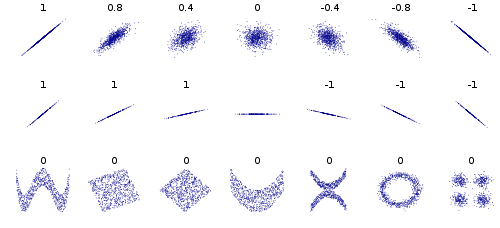
it's great at picking up linear relationships, but other relationships (periodic sine waves, parabolas, exponential functions, circular associations) it's not so good at.
Second, we would like it to be what we call equitable. By this we mean that scores should degrade with noise at (roughly) the same rate. If you start with a line and start with a sine wave, and add an equivalent amount of noise to both of them in the same way, the resulting scores should be about the same; otherwise the method would give preference to some types of relationships over others.
I should point out that the goal behind these properties is to allow exploration -- the point is you don't know what sort of patterns in the data you should be looking for. If you do know, you're probably better off using a specific tests. If you're looking for linear relationships, Pearson is great -- and there are a large variety of powerful tests that have been developed for specific types of relationships over the years.
Our suggested measure, MIC (maximal information coefficient), is based on mutual information, but is different from it. Our intuition is that if a relationship exists between two variables, then a grid can be drawn on the scatterplot that partitions the data in a way that corresponds to that relationship. Suppose we have a grid, with x rows and y columns; then this grid induces a probability distribution, where the probability associated with a box on the grid is proportional to the number of data points it contains. Let I_G be the mutual information of the grid. We aim to maximize I_G/ log min(x,y) -- this is the MIC score. (We bound x, y values to avoid trivial cases like every point having its own box; see the paper for more details.) MIC values are between 0 and 1, and we can approximately compute MIC values heuristically. Our work shows via a mix of proofs and experiments that MIC appears to have the properties of generality and equitability we desire.
Based on the approach we use to find MIC, we suggest several other possible useful measures, and we refer to the collection as MINE (maximal information-based nonparametric exploration) statistics. For example, MIC - Pearson^2 turns out to be a useful measure for specifically finding nonlinear relationships. When MIC is high (close to 1) and Pearson is low (close to 0), there is a relationship that MIC has found but it is not a linear one; for linear patterns, both MIC and Pearson are high, and so this measure is close to 0. Other measures we have measure things like deviations from monotonicity -- useful for finding periodic relationships.
Should MIC/MINE prove useful, I believe there's lots of theoretical questions left to consider. The approach is currently essentially heuristic, although we do prove a fair number of things about it. Proving more about its properties would be useful, as well as improving the complexity to compute the relevant measures.
Next up: more about the experience of working on this project.
Sunday, December 18, 2011
Congratulations to Hanspeter Pfister
Despite our really very good track record for the last decade or so, there are some people out there who remain under the misimpression that it's impossible to get tenure at Harvard.
So I'm very happy to announce that Hanspeter Pfister has achieved the impossible, and is now a tenured Harvard Professor.
Hanspeter works in graphics and visualization, doing the usual sort of things like replacing your face in videos and designing 3-d printers that work like a Star Trek replicator. But he has also developed a large number of collaborations with domain scientists, finding interesting and important visualization problems in things like diagnosing heart disease and mapping the brain.
We're all happy he'll be staying around. Hooray for Hanspeter!
Friday, December 16, 2011
This Week, I Am A Scientist
This week, I am a scientist; I know this, because I have an article in Science.
It's nice to have something to point to that my parents can understand. I don't mean they'll understand the paper, but they'll understand that getting a paper in Science is important, more so than my papers that appear other places. And because they're probably reading this, I will also point them to the Globe article appearing today about the work, even though the article rightly focuses on the cool and unusual fact that the lead authors are two brothers, David and Yakir Reshef.
I had been planning to write one or more posts about the paper -- both the technical stuff and the great fun I've been having working with David, Yakir, my long-time colleague Hilary Finucane, the truly amazing systems biology professor Pardis Sabeti, and others on this project. (See Pardis's Wikipedia page or this site to see how Pardis rocks!) But between Science's "news embargo" policies and my own end-of-semester busy-ness, I blew it. I'll try to have them out next week. But for now, for those of you who might be interested, here's the link to the project web page, and here's the abstract:
Detecting Novel Associations in Large Data Sets
Abstract: Identifying interesting relationships between pairs of variables in large data sets is increasingly important. Here, we present a measure of dependence for two-variable relationships: the maximal information coefficient (MIC). MIC captures a wide range of associations both functional and not, and for functional relationships provides a score that roughly equals the coefficient of determination (R2) of the data relative to the regression function. MIC belongs to a larger class of maximal information-based nonparametric exploration (MINE) statistics for identifying and classifying relationships. We apply MIC and MINE to data sets in global health, gene expression, major-league baseball, and the human gut microbiota and identify known and novel relationships.Thursday, December 15, 2011
Consulting
As I've probably mentioned, I generally enjoy my consulting work. Besides the obvious remunerative aspects, consulting provides challenges, insights, and experiences that are quite different from academic work.
On the other hand, taking red-eyes and having to get up at 4 am for a 6 am flight to a meeting in another city -- both of which I had to do this week -- I could happily do without.
On the other hand, taking red-eyes and having to get up at 4 am for a 6 am flight to a meeting in another city -- both of which I had to do this week -- I could happily do without.
Wednesday, December 14, 2011
Grading
Some folks at the NSDI meeting were nice enough to say that it was nice that I was blogging again. Sadly, I've been under-the-gun busy for the last several weeks, but it was a reminder that I should be getting back to this now and again.
One thing that's taken my time the last week is grading. I was teaching my graduate course this semester, on randomized algorithms and probabilistic analysis, using my book as the base. Unfortunately, I teach this course at most every other year, which means it's hard if not impossible to find a suitable TA. (As for my own students, Zhenming is on an internship this semester; Justin's on fellowship and essentially required not to TA. Also, both have been extremely busy this semester doing really great work, so why would I want them to TA instead of doing their research now anyway?) So this year I didn't have one. Which means I graded things myself.
It's been a while since I've graded a whole course. I do grade exams (with the TAs) and one full assignment (myself) every year in my undergraduate class. But grading every week is really at least as bad as having to do homework every week. I'd say worse; very little interesting thinking involved, just a lot of reading, checking, and moving papers or files around in a time-consuming fashion. Somehow, though, I don't think the students sympathize.
I think I remember one graduate class in Berkeley where a student (or maybe a group of students) were required to take on the grading every assignment. I like that plan. In fact, right now I like any plan that doesn't involve me grading the next time I teach this class. One plan is of course no/minimal homework, or homework without grades. However, I do believe students learn by doing homework, and I've found that in most circumstances a grade is the motivator that makes them get the homework done, so I'll have to find a plan that involves grading somehow.
Tuesday, December 06, 2011
Plane Work
I dislike flying, but I have a few flights coming up.
I find that engaging in "real thinking" about problems while on a plane is generally beyond me. (I'm jealous of all of you that somehow manage this.) Similarly (or Even) writing code takes more focus than I can manage on a plane. But I do try to make my plane time useful.
Luckily, it's the end of the semester, so I think I'll be bringing the last homeworks and final exams to grade on board this time around.
Reviewing (conference) papers is something I manage on plane flights. I'm sure that says something about the level of my reviews. On the plane my goal isn't to read the paper in same depth that I'd read a paper I'm trying to understand for my research; it's to assign a score (sort) and write down useful comments. (Which, I guess, is my goal for conference reviews off the plane as well. And why I wouldn't do journal reviews on planes.) If you get a review you don't like, I suppose now you can always assume you can assign the blame to the fact that I was on a long plane flight. But I don't think I'll have any reviews this month.
Reviewing proposals is even better than reviewing conference papers on a plane. I often get foreign governments sending me proposals to review for them, and they often pay some nominal amount. If I know I have a flight coming up, I sometimes say yes. It makes me feel like I'm doing something useful on the flight, and even getting paid for it.
When all that fails, I try to read a mindless book. (It's always good to have one on hand for those interminable periods where your electronic devices must be turned off.) I slipped up and started reading V is for Vengeance at home. (I think I've read all the Kinsey Millhone books from A, but I started at around H, and can't recall if I found all the earlier ones. I wonder what she'll do after Z?) I've been saving Mockingjay
 for a plane flight though. (I try to read what my kids read. So I'm also quite familiar with Percy Jackson.) I've read most of Robert Parker's books
 in the air.
Finally, sometimes, I fall asleep. I've gotten reasonably good at sleeping on flights. Then I don't get the work I thought I'd get done on the plane done. But it definitely feels like a good use for the time.
I find that engaging in "real thinking" about problems while on a plane is generally beyond me. (I'm jealous of all of you that somehow manage this.) Similarly (or Even) writing code takes more focus than I can manage on a plane. But I do try to make my plane time useful.
Luckily, it's the end of the semester, so I think I'll be bringing the last homeworks and final exams to grade on board this time around.
Reviewing (conference) papers is something I manage on plane flights. I'm sure that says something about the level of my reviews. On the plane my goal isn't to read the paper in same depth that I'd read a paper I'm trying to understand for my research; it's to assign a score (sort) and write down useful comments. (Which, I guess, is my goal for conference reviews off the plane as well. And why I wouldn't do journal reviews on planes.) If you get a review you don't like, I suppose now you can always assume you can assign the blame to the fact that I was on a long plane flight. But I don't think I'll have any reviews this month.
Reviewing proposals is even better than reviewing conference papers on a plane. I often get foreign governments sending me proposals to review for them, and they often pay some nominal amount. If I know I have a flight coming up, I sometimes say yes. It makes me feel like I'm doing something useful on the flight, and even getting paid for it.
When all that fails, I try to read a mindless book. (It's always good to have one on hand for those interminable periods where your electronic devices must be turned off.) I slipped up and started reading V is for Vengeance
at home. (I think I've read all the Kinsey Millhone books from A, but I started at around H, and can't recall if I found all the earlier ones. I wonder what she'll do after Z?) I've been saving Mockingjay for a plane flight though. (I try to read what my kids read. So I'm also quite familiar with Percy Jackson.) I've read most of Robert Parker's books in the air. Finally, sometimes, I fall asleep. I've gotten reasonably good at sleeping on flights. Then I don't get the work I thought I'd get done on the plane done. But it definitely feels like a good use for the time.
Saturday, December 03, 2011
The End (of the Semester) is Nigh
If you've missed it (which probably means you're not a theorist and/or a blog-reader), you should check out the (entertaining) controversies of the last week or two, starting with Oded's guest post on the decline of intellectual values in Theoretical Computer Science, and then whether a lowering of the matrix multiplication exponent counts as a "breakthrough" (see follow-up blog posts here, here, and here).
I've enjoyed watching them develop, but have been happy to let them go on without putting a big target on my back. I've also been too busy getting through my last lectures, making up a final exam, trying to get some grant proposals ready on ridiculous deadlines, and dealing with administrative issues like prepping slides for an end-of-semester faculty retreat. Occasionally I try to fit in meeting with students and (last of all) working on research. I know the end of the semester is a mad rush for students, finishing projects and papers and getting ready for exams. Sadly, I feel the same way this year. Another week or two and it will be all over, and like the students I think I'm ready to let things go for a couple of weeks of holiday time.
But probably I'll stay up late after the kids are in bed and try to do some of that research stuff. There are some fun problems that have been waiting for attention most of the semester, and I'd like to see what happens if I'm finally able to give them some.
Thursday, December 01, 2011
Letters of Recommendation Time. Ugh.
I don't mind writing letters of recommendation for students. It's part of the job. It's a good thing to do.
I just mind dealing with the new e-application sites. I'd rather hand my letter off to an admin and have them send it. The good old days...
To see what I'm talking about, I'm now a huge non-fan of Embark -- here's their "help page", which explains that I may have to wait 5+ minutes for my pdf to upload, without really explaining why
Monday, November 21, 2011
Round Two Reviewing : An Exercise in Conditional Probabilities
We're in "round 2" of reviews for NSDI, and it's brought up a problem for me I've noticed before. I worry that, subconsciously, I'm inclined to give papers I read on the second round a higher score, since I'm swayed by the fact that they've in fact made it to the second round.
I wonder if anyone in the PC world has done any testing of this to see if it's a real phenomenon. Are second round reviews on a set of papers statistically different from the first round of reviews? I would bet yes, even controlling for the fact that the papers made it to the second round. In particular, I'd suspect it's much harder for people to give a score of 1 (=reject) to a second round paper.
One could imagine attempting to test for this by sticking a few obvious rejects from the first round into the second round reviews. Indeed, perhaps one should make this part of the process: randomly select a few clear rejects to go into round two, and announce that you're doing this to the PC. Then they might not feel so averse to assigning a score of 1 in the second round.
One joy in the second round reviews is once you submit a review you get to see the first round reviews. So far, I feel I've been calling them fairly; when I haven't liked a second round paper, the first round reviews seem to confirm my opinion. So perhaps (with some effort) I'm keeping my subconscious at bay successfully, and not conditioning on the fact that it's a round 2 review.
Wednesday, November 16, 2011
Public University Budgets
Another topic that arose in conversations during my visit to Wisconsin was the issue of budgets, and in particular the large-scale cuts that many of the best US public school are having to deal with. It's not hard to find information on this. My first search on Google yielded this article about what's going on in Wisconsin (taking choice quotes, not the full article; it's from June).
Public universities generally have been faring quite badly in the current financial crisis. I have a deep pro-education bias, unsurprisingly, so I find this depressing. But also, in my mind, it's just not sound financial sense. I believe these cuts today will yield a corresponding decline in Wisconsin's economy tomorrow, for some appropriate notion of tomorrow. A dollar spent on education should be worth... well, I don't know how much it should be worth, but my guess is the multiplier on the dollar is pretty high. I'd like more information to back that up. If you know of any studies that demonstrate the payoff for education -- the sort of thing all of us in the education field should have on hand when discussions like this come up -- please leave them in the comments. It would be nice to have a collection handy.
Wis. Gov. signs budget cutting education $1.85BI'm sure the children and grandchildren he talks about, who will have to face the new challenge of increased global competition with an increasingly better educated non-Wisconsin population instead of the challenges being faced today, will be very appreciative.
Democrats assailed the budget as an attack on middle class values since it cuts funding for public schools by $800 million, reduces funding to the UW system by $250 million and cuts tax credits for poor people.
It also reduces the amount schools can collect from property taxes and other revenue combined, which translates into another education cut of about $800 million. While schools are seeing deep cuts, Walker's budget extends tax breaks to manufacturers, multistate corporations and investors.
"As a state, we can choose to take the easy road and push off the tough decisions and pass the buck to future generations, or we can step up to the plate and make the tough decisions today," Walker said in prepared remarks. "Our budget chooses to fix our problems now, so that our children and our grandchildren don't face the same challenges we face today."
Public universities generally have been faring quite badly in the current financial crisis. I have a deep pro-education bias, unsurprisingly, so I find this depressing. But also, in my mind, it's just not sound financial sense. I believe these cuts today will yield a corresponding decline in Wisconsin's economy tomorrow, for some appropriate notion of tomorrow. A dollar spent on education should be worth... well, I don't know how much it should be worth, but my guess is the multiplier on the dollar is pretty high. I'd like more information to back that up. If you know of any studies that demonstrate the payoff for education -- the sort of thing all of us in the education field should have on hand when discussions like this come up -- please leave them in the comments. It would be nice to have a collection handy.
Tuesday, November 15, 2011
Yes, We Are Hiring (2012)
Harvard CS will be hiring this year.
One tenure-track position is geared toward systems, very broadly defined.
A second tenure-track position is in Applied Math, where we're aiming for a "discrete applied math" person. The right CS theory person could fit just fine. And if we see great CS theory people who really want to be in CS rather than AM, we should be able to find a way to make that work.
Here's the link to the ad for both. Here's the URL: https://www.seas.harvard.edu/csjobs. And the ad text follows. Spread the word!
Candidates are required to have a PhD or an equivalent terminal degree, or to be able to certify that they will receive the degree within one year of the expected start date. In addition, we seek candidates who have an outstanding research record and a strong commitment to undergraduate teaching and graduate training.
Position 1: Computer Science. We welcome outstanding applicants in all areas of computer science. We are particularly interested in systems, broadly defined, including compilers, programming languages, distributed systems, databases, networking, and operating systems. Applicants will apply online at http://academicpositions.harvard.edu/postings/3825.
Position 2: Applied Math/Computer Science. We welcome outstanding applicants in all areas of applied mathematics or theoretical computer science. We are particularly interested in topics at the boundary or intersection of these fields, including optimization, applied probability, scientific computing, combinatorics and graph theory, approximation algorithms, and numerical analysis. Applicants will apply on-line at http://academicpositions.harvard.edu/postings/3824.
In terms of applications, areas of interest include computational science, engineering, or the social sciences. We encourage applications from candidates whose research examines computational issues raised by very large data sets or massively parallel processing.
The Computer Science and Applied Mathematics programs at Harvard University benefit from outstanding undergraduate and graduate students, an excellent location, significant industrial collaboration, and substantial support from the Harvard School of Engineering and Applied Sciences. Information about Harvard's current faculty, research, and educational programs is available at http://www.seas.harvard.edu.
Required documents include a CV, a statement of research and teaching interests, up to three representative papers, and names and contact information for at least three references.
Applications will be reviewed as they are received. The review of applications will begin on December 15, 2011, and applicants are strongly encouraged to submit applications by that date; however, applications will continue to be accepted at least until January 15, 2012.
Harvard is an Equal Opportunity/ Affirmative Action Employer. Applications from women and minority candidates are strongly encouraged.
One tenure-track position is geared toward systems, very broadly defined.
A second tenure-track position is in Applied Math, where we're aiming for a "discrete applied math" person. The right CS theory person could fit just fine. And if we see great CS theory people who really want to be in CS rather than AM, we should be able to find a way to make that work.
Here's the link to the ad for both. Here's the URL: https://www.seas.harvard.edu/csjobs. And the ad text follows. Spread the word!
Tenure-Track Positions in Computer Science and Applied Mathematics
The Harvard School of Engineering and Applied Sciences (SEAS) seeks applicants for positions at the level of tenure-track assistant professor in the fields of Computer Science and Applied Math/Computer Science, with an expected start date of July 1, 2012.Candidates are required to have a PhD or an equivalent terminal degree, or to be able to certify that they will receive the degree within one year of the expected start date. In addition, we seek candidates who have an outstanding research record and a strong commitment to undergraduate teaching and graduate training.
Position 1: Computer Science. We welcome outstanding applicants in all areas of computer science. We are particularly interested in systems, broadly defined, including compilers, programming languages, distributed systems, databases, networking, and operating systems. Applicants will apply online at http://academicpositions.harvard.edu/postings/3825.
Position 2: Applied Math/Computer Science. We welcome outstanding applicants in all areas of applied mathematics or theoretical computer science. We are particularly interested in topics at the boundary or intersection of these fields, including optimization, applied probability, scientific computing, combinatorics and graph theory, approximation algorithms, and numerical analysis. Applicants will apply on-line at http://academicpositions.harvard.edu/postings/3824.
In terms of applications, areas of interest include computational science, engineering, or the social sciences. We encourage applications from candidates whose research examines computational issues raised by very large data sets or massively parallel processing.
The Computer Science and Applied Mathematics programs at Harvard University benefit from outstanding undergraduate and graduate students, an excellent location, significant industrial collaboration, and substantial support from the Harvard School of Engineering and Applied Sciences. Information about Harvard's current faculty, research, and educational programs is available at http://www.seas.harvard.edu.
Required documents include a CV, a statement of research and teaching interests, up to three representative papers, and names and contact information for at least three references.
Applications will be reviewed as they are received. The review of applications will begin on December 15, 2011, and applicants are strongly encouraged to submit applications by that date; however, applications will continue to be accepted at least until January 15, 2012.
Harvard is an Equal Opportunity/ Affirmative Action Employer. Applications from women and minority candidates are strongly encouraged.
Monday, November 14, 2011
Public Salary Information
While visiting Wisconsin last week (enjoying very pleasant company and conversation), various issues came up.
For one, I was reminded (or recalled) that as a public university, University of Wisconsin-Madison salaries are available online. I can understand why salaries of elected public officials, and the people they hire, should be public information. Transparency in politics is a valuable thing.
But I don't see that professor's salaries should be public. Perhaps this is merely a personal bias; I wouldn't want MY salary to be public information.** I also don't use Facebook, so perhaps I'm just a 20th century privacy-desiring relic. Perhaps more reasonably, I don't see university faculty as political employees, and therefore think they -- as well as the university -- should enjoy the same privacy for salary information that other employers and employees enjoy.
Perhaps, however, I'm just wrong, and transparency of salary information is good for all. I'm willing to entertain that thought. Certainly I think the Taulbee survey that aggregates salary information is useful and good information, for both universities and faculty, as I think there's a shortage of accurate comparative salary information for faculty positions (as compared to other jobs), and the Taulbee survey provides an important information baseline. Is it so far to go from there to individual's salaries?
How do those of you at schools where your salary information is public information feel about this? And the rest of you?
** Although perhaps in some sense it is. I don't believe my NSF grant budgets are publicly accessible information, but at some point, I was informed by my university that a Freedom of Information Act request had been made for one of my funded proposals. (I don't know why, though I have some suppositions.) The university filed paperwork to hopefully make sure that personal information, including my salary, would be redacted.
Thursday, November 10, 2011
CAEC: First Cambridge Area Economics and Computation Day
Wednesday, November 09, 2011
Programming for Non-Programming Exercises
One of the exercises I assigned last week proved interesting:
Consider n points on a circle, labeled clockwise from 0 to n-1. Initially a wolf begins at 0 and there is a sheep at each of the remaining n-1 points. The wolf takes a random walk on the circle; at each step, it moves with probability 1/2 to one neighbor and with probability 1/2 to the other neighbor. (0 and n-1 are neighbors.) The first time the wolf visits any point it eats the sheep that is there. (The wolf can return to points with no sheep.) Which sheep is most likely to be the last eaten?
If you haven't seen it before, you might try it; don't put the answer in the comments, though, since I'll use the problem again.
While grading the assignment, I found a number of students had simulated the process, figured out the answer from the simulations, and then used that knowledge to prove the desired result. The problem didn't ask for them to do it, but they did it themselves.
That was great (and I told them so). That's how solving research problems often works for me. I have to understand what's going on, and in many cases, that understanding comes about by simulating a process to figure out how things behave. Then I go back and try to prove what I think I'm seeing in the simulations.
My worry, though, is that the students that did it this way were primarily the "non-theorists" in the class, who did it because they knew they didn't know the answer, and thought it was easier to code to figure it out. And that the "theorists" in the class correspondingly thought they knew the answer (rightly or wrongly) and went ahead with the calculations without doing a simulation. That's not necessarily a bad thing, certainly not for this problem (which is easy enough), but I'd also like for the theorists to also get into a mindset of doing simulations in this sort of setting, both as a tool to gain insight before trying to prove things and as a check on their proofs.
I think they're probably getting the lesson from other, harder exercises I give. Still, it was nice that a number of people in the class went that direction (and thought to write it down in their assignment).
Monday, November 07, 2011
A Tale of Talks
A bunch of talks today.
Carla Gomes gave a talk at CRCS (Harvard's Center for Research on Computation and Society) to talk about her work on computational sustainability -- interdisciplinary research with "the overall goal of developing computational models, methods, and tools to help manage the balance between environmental, economic, and societal needs for sustainable development." How to use optimization, machine learning, and math and computation more generally to help with problems in "the real world", like designing paths for animal migration or designing control systems for energy-efficient buildings. Fun stuff.
Then I had to take Harvard's M2 shuttle over to the Medical School Area for the Broad Institute's annual retreat. Some students who I have been working with on a project spanning systems biology, computer science, and statistics were giving a 15-minute presentation of their results. (More on the work at some later date.) The scale there is a bit larger than I'm used to; I think over 1000 people were listening to the talk, which might well make it the most seen presentation of my work (even if we sum over multiple presentations of the same talk). Happily, the students really nailed it, both in the presentations and the follow-up Q and A.
Then the shuttle back for Mark Zuckerberg's Q and A session at Harvard. I don't think I've seen him speak before, and he's actually much more well spoken than one might expect if you saw The Social Network. He was entertaining and captivating, and I'm sure inspired many of our students. It was a full room -- you needed to get a ticket to get in. I understand recruiting sessions with students are taking place sometime after. If there are good writeups I'll link to one here later.
I also have my own talks to work on. I'll be giving two talks at U. of Wisconsin this week. One "old" talk on cuckoo hashing, and one "new" talk on verification using streaming interactive proofs. Come on by if you're in the area. (Of course, I suspect if you're in the area, you're probably a student or faculty member of U. of Wisconsin.)
Friday, November 04, 2011
Funny E-mail of the Day
I've having some issues getting straight answers over e-mail from an administrator in some Harvard office I'm dealing with. This morning, I found the following e-mail in my inbox:
Well, now, this is entirely the problem, isn't it?
Dear Mmichael,
To be clear,
Sent from my iPad
Well, now, this is entirely the problem, isn't it?
Wednesday, November 02, 2011
This Week, We Were Doing Security
If you look on Yelp's engineering blog (http://engineeringblog.yelp.
Before beginning, though, we should say that Yelp's team responded in what seems to us to be an exemplary fashion. After we contacted them, Michael Stoppelman and members of the engineering staff listened to our presentation and description of the vulnerability seriously, and, as they describe in their blog post, took immediate action to correct the problem. While it would be fun to have a security horror story to tell (right around Halloween) of a big company not taking the leakage of user information, or us as researchers, seriously, that absolutely was not the case here. Indeed, when we expressed that we should make the issue public after the problem was fixed, both to transparently inform their users and to possibly help prevent a similar problem on other web sites, they agreed to write a blog post about it, and let us read the copy in advance to make changes or offer suggestions -- and except for making sure Harvard, Yale, and Boston University were all credited, we didn't have any to add.
As people may know from our previous work, we have been studying sites such as Yelp, as they provide an interesting case study as a social network that provides economic information in the form of reviews. As part of our research and data collection, Giorgos was looking at their various interfaces, including the Yelp mobile web site. To be clear, he was not ``hacking'' the site in any way, just interacting with it via a standard browser and normal HTTP requests. He found that when he checked a restaurant for reviews, and subsequently clicked on the button asking for more reviews, entire reviewer records were leaked in JSON format, in the manner described in Yelp's blog post. While this data was present in HTTP replies, and was visible to an HTTP logger such as Firebug for Firefox, or via the built-in logger for Chrome, ordinary users accessing the site from a device such as an iPhone would not observe sensitive information, as client-side Javascript displayed only the non-sensitive information (such as the review text, date, and the user's handle). This example shows the importance of having multiple redundant layers of security when handling personally identifiable information; in the Yelp post, they describe the redundancies they have added to prevent such leakage in the future.
While there was no financial information involved, it seemed to us to be a severe hole, in that personally identifiable information was being sent in the clear in response to a normal and seemingly not infrequent user request. We spent some time verifying what we saw, checking that we were not mistaken and that the vulnerability could potentially leak information at scale. When we were fully convinced the problem was both real and significant, we contacted Yelp.
We did have concerns as we went; we have heard stories of some businesses blaming the messenger when approached with significant security issues. We were pleased that Yelp responded by thanking us rather than blaming us. In our minds, this was a very positive interaction between university researchers and an Internet business.
Giving credit where credit is due, Giorgos deserves the lauds for finding the problem and thereby protecting a lot of user data.
Thursday, October 27, 2011
Lisa Randall on the Daily Show
Last night's Daily Show (link to full episode) was on fire.
The first segment was focused on SCIENCE! The part with Aasaf Mandvi was simultaneously hysterical and very, very, very sad.
The last segment had guest Lisa Randall -- Harvard physicist and author of the new book Knocking on Heaven's Door: How Physics and Scientific Thinking Illuminate the Universe and the Modern World as well as the old book Warped Passages: Unraveling the Mysteries of the Universe's Hidden Dimensions -- talking about science also. While I understand Lisa has many tremendous accomplishments, appearing on the Daily Show is the one I am jealous of.
The first segment was focused on SCIENCE! The part with Aasaf Mandvi was simultaneously hysterical and very, very, very sad.
The last segment had guest Lisa Randall -- Harvard physicist and author of the new book Knocking on Heaven's Door: How Physics and Scientific Thinking Illuminate the Universe and the Modern World
as well as the old book Warped Passages: Unraveling the Mysteries of the Universe's Hidden Dimensions -- talking about science also. While I understand Lisa has many tremendous accomplishments, appearing on the Daily Show is the one I am jealous of.
Wednesday, October 26, 2011
Students are Awesome(ly Productive Right Now)
What's the use of a blog if you can't brag about your students? And my students have all been doing great stuff, so I'm excited to let others know about their work. In random order...
Zhenming Liu's paper Information Dissemination via Random Walks in d-Dimensional Space will be appearing in SODA 2012. It looks at a very natural random walk diffusion question that hadn't been solved. Here's the arxiv version, and a slightly edited down abstract:
Zhenming Liu's paper Information Dissemination via Random Walks in d-Dimensional Space will be appearing in SODA 2012. It looks at a very natural random walk diffusion question that hadn't been solved. Here's the arxiv version, and a slightly edited down abstract:
We study a natural information dissemination problem for multiple mobile agents in a bounded Euclidean space. Agents are placed uniformly at random in the $d$-dimensional space $\{-n, ..., n\}^d$ at time zero, and one of the agents holds a piece of information to be disseminated. All the agents then perform independent random walks over the space, and the information is transmitted from one agent to another if the two agents are sufficiently close. We wish to bound the total time before all agents receive the information (with high probability). Our work extends Pettarin et al.'s work, which solved the problem for $d \leq 2$. We present tight bounds up to polylogarithmic factors for the case $d \geq 3$.Justin Thaler's paper on Practical Verified Computation with Streaming Interactive Proof was accepted to ITCS 2012. I think part of its "innovation" is how well Justin puts together the theory with the implementation, showing how practical this line of work could be. Here's the arxiv version, and again a slightly edited down abstract:
When delegating computation to a service provider, as in cloud computing, we seek some reassurance that the output is correct and complete. Yet recomputing the output as a check is inefficient and expensive, and it may not even be feasible to store all the data locally. We are therefore interested in proof systems which allow a service provider to prove the correctness of its output to a streaming (sublinear space) user, who cannot store the full input or perform the full computation herself. Our approach is two-fold. First, we describe a carefully chosen instantiation of one of the most efficient general-purpose constructions for arbitrary computations (streaming or otherwise), due to Goldwasser, Kalai, and Rothblum. This requires several new insights to make the methodology more practical. Our experimental results demonstrate that a practical general-purpose protocol for verifiable computation may be significantly closer to reality than previously realized. Second, we describe techniques that achieve genuine scalability for protocols fine-tuned for specific important problems in streaming and database processing.Finally, Giorgos Zervas's work on Daily Deals: Prediction, Social Diffusion, and Reputational Ramifications, which I've already discussed on the blog since it got so much press play, was also just accepted to WSDM. Giorgos is no longer my student, but working with me and Joan Feigenbaum as a postdoc, so I'll count him in the mix.
Subscribe to:
Posts (Atom)